What Is Mammoth Ivory?
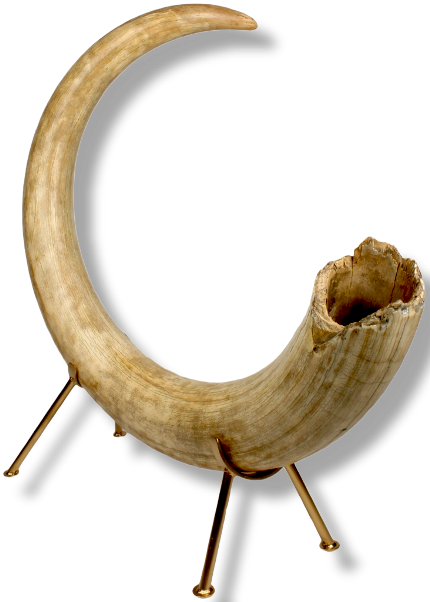
Mammoth ivory is the tusk material of the woolly mammoth (Mammuthus primigenius), an Ice Age relative of today's elephants that has been extinct for thousands of years. Recovered mainly from the permafrost of Siberia, it is one of the very few genuinely ancient natural materials that can still be traded and worked today, and it is valued by craftspeople and collectors alike.
It is also easily misunderstood. Mammoth ivory is not elephant ivory, it is not stone, and it does not come in a single form. The same tusk has two distinct parts — the creamy white ivory of its inner core and the richly coloured bark of its outer layer — while the animal's molars are a different material altogether. Where mammoth ivory comes from, what it is made of, how it differs from elephant ivory and how it is prepared all shape what a maker or collector can do with it, and they explain how our selection of well over 1,500 pieces is organised.
From the Ice Age to the Permafrost
The woolly mammoth died out on the mainland at the end of the last Ice Age. A last, isolated population survived on Wrangel Island in the Arctic Ocean until about 4,000 years ago, several thousand years after its mainland relatives had disappeared. The story of the animal itself is told in "What is a Woolly Mammoth?"
Its remains have survived because they lie in permafrost — ground that stays frozen year after year. According to the CITES Secretariat, the majority of woolly mammoth carcasses are found in Siberia, and approximately 80% of the fossil mammoth ivory originates from Yakutia, the Sakha Republic. As the frozen ground thaws and erodes, often along rivers and lakes, tusks are exposed and recovered.
Most of what emerges is fragmentary: cracked, weathered and encased in ancient mud. A whole tusk in good condition is the exception, and a matched pair from the same animal is rarer still.
Fossil, but Not Stone
Mammoth ivory is rightly called fossil ivory: it is the preserved remains of an extinct animal. It is not, however, petrified. In a petrified fossil the original material has been replaced by minerals, leaving stone in the shape of the original object. Mammoth ivory from the permafrost has not undergone that substitution, which is why it is more precisely described as subfossil.
The difference is measurable. A study published in Scientific Reports in 2019 examined well-preserved mammoth ivory from the Siberian permafrost and found its composition and mechanical properties comparable to those of ivory from modern African elephants. That is why mammoth ivory saws, carves and polishes like ivory rather than like stone. What remains of its original structure, and how that allows independent scientific testing, is explained in "How to Identify Genuine Mammoth Ivory (and Spot Fakes)."
The Anatomy of a Tusk: Ivory, Bark and Molar
A mammoth tusk is a greatly enlarged incisor tooth. Its structure explains the different forms in which mammoth material is offered.
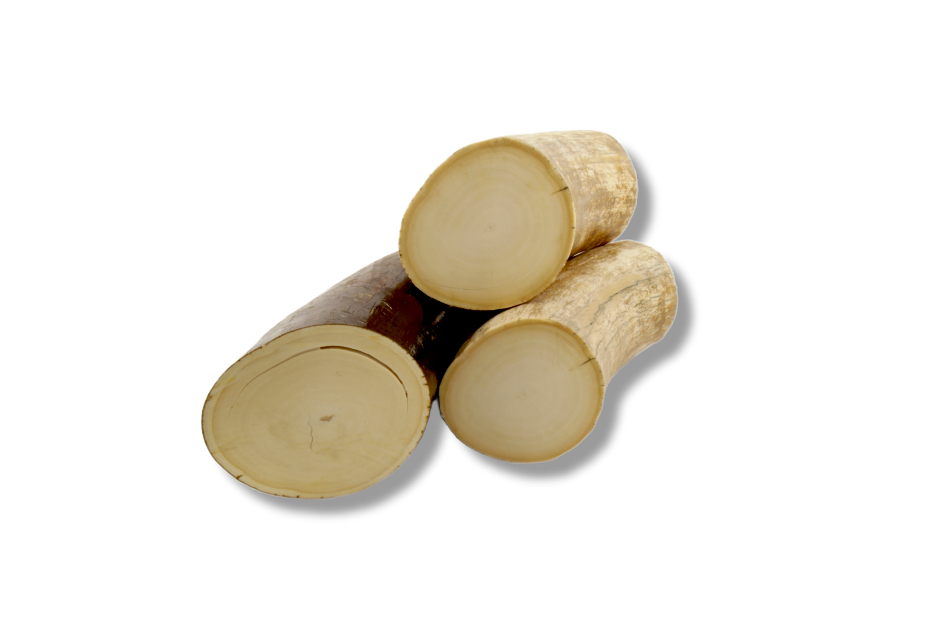
Inner ivory. The main body of the tusk is dentine, the creamy, yellowish-white material most people picture when they hear the word ivory.
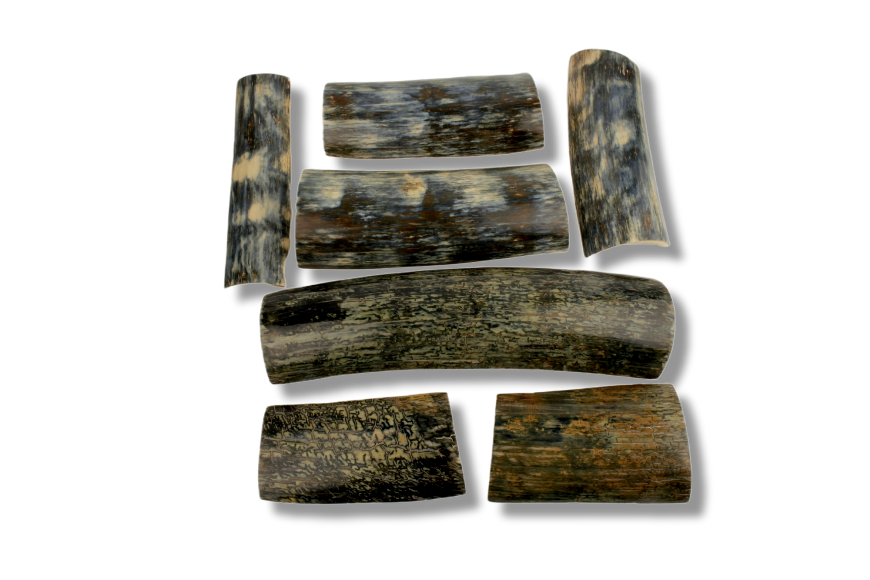
Bark. The outer layer of the tusk, known in the trade as mammoth bark, spent millennia in contact with the surrounding ground and is coloured accordingly. Brown is the most common colour, in tones from honey to deep chocolate, and comes from iron and manganese minerals that crystallised on the surface during burial. Rarer blue tones are associated with vivianite, an iron phosphate that forms as iron entering the tusk reacts with the phosphate in the ivory. Bark and inner ivory come from the same tusk and are worked with the same tools: the difference lies in position, not material, as explained in "Mammoth Ivory vs Mammoth Bark: What is the Difference?"
Molar. Mammoth molars are not part of the tusk at all, but the animal's grinding teeth, built from enamel, dentine and cementum. Fossil molar is porous and fragile, so every piece we offer has been professionally stabilised with resin before it can be worked. How to handle it is set out in "Processing Stabilised Mammoth Molars."
Mammoth Ivory and Elephant Ivory
Cut and polished, mammoth and elephant ivory can look alike. They come from different animals, however, and they are governed by different law.
One of the main visual features used to distinguish the two is the Schreger pattern: the cross-hatched lines visible in a polished cross-section of any proboscidean tusk. Where the outer lines intersect, mammoth ivory characteristically shows acute angles, averaging below 90°, while modern elephant ivory shows obtuse angles, averaging above 115°. Measurements between 90° and 115° are genuinely ambiguous and cannot settle the question on their own. The blue vivianite colouring found on some mammoth bark is a further indicator, since the CITES identification guide records that elephant ivory does not show it in its natural state. The method and its limitations are set out in full in "How to Identify Genuine Mammoth Ivory (and Spot Fakes)."
In law, the woolly mammoth is not listed under CITES, because it is extinct. In 2025 the CITES Secretariat reported that trade in mammoth ivory is generally legal and that prohibitions are not widespread among CITES Parties. India and Israel are the only Parties where trading in mammoth ivory is illegal throughout their territories, and several US states have bans of their own. The position country by country is examined in "Is Mammoth Ivory Legal? A Buyer's Guide to CITES, National Law and Customs."
Mammoth ivory also features in the wider debate over elephant conservation. A peer-reviewed economic study estimated that Russian exports of mammoth ivory lowered the price of elephant ivory, and in its 2025 review the CITES Secretariat concluded that available information seems to suggest the growth of the mammoth ivory trade might have contributed to reducing the price of and demand for elephant ivory, while recording the opposing view that any such effect may be temporary because mammoth ivory is not renewable. On balance, the Secretariat found that bringing mammoth ivory under CITES would have limited benefit and might even be counterproductive.
A Material for Makers
People have valued mammoth ivory for millennia. Ice Age communities across the northern hemisphere used it for art and adornment, and also for tools. Research published in Scientific Reports concluded that its combination of stiffness, toughness and size made it the most suitable of the bone, antler and ivory raw materials available for heavy hunting points.
Those same qualities explain why it remains a material of choice today. Our clients include knifemakers and bladesmiths, gunsmiths, jewellers and goldsmiths, watchmakers, pen-turners, engravers, scrimshanders, sculptors and makers of musical instruments. Many of them are among the best in their field, and many began in other materials before moving to mammoth ivory.
"Mammoth ivory is a far superior product, compared to illegal elephant ivory," says Sergey Gouralnik, son of the company's founder. "It is rarer, much older and offers an astonishing variety of colours which are simply not present in elephant ivory. When you hold a piece of mammoth ivory, you have an ancient fossil in your hands which has been preserved for thousands of years in permafrost … it's quite mind-boggling when you think about it in those terms. There is no comparison."
"Many of our clients have converted and adapted to working with mammoth ivory and have fallen in love with it," he adds. "My mission is to educate and raise awareness."
Practical advice on sawing the material, without cooling liquids and with the right blades, is given in "Cutting Mammoth Ivory."
From Permafrost to Workshop
Fresh from the permafrost, a mammoth tusk is barely recognisable. It is covered in mud, it holds moisture in its core, and its colours are hardly visible. It must first be cleaned, then dried slowly under controlled conditions — a process that usually takes a few years, depending on how much moisture the particular tusk contains. Our white segments are dried under controlled temperature conditions for at least five years.
Once dry, every tusk is inspected to decide whether it can be offered in its natural state or needs restoration. A natural tusk is one recovered whole and offered without restoration. A restored tusk has been professionally treated: typically, cracks have been filled with epoxy and, where necessary, the tusk has been stabilised from the inside with resin in a vacuum chamber and then a pressure chamber, leaving an outer colouration that mixes natural and artificial colours. The distinction is explained in "Natural vs Restored Mammoth Tusks."
Stabilisation is also used for smaller material. Stabilised mammoth ivory has been impregnated with a specially mixed resin under vacuum, consolidating natural cracks and producing solid material ready for precision work. It remains genuine mammoth ivory that has been treated, and we describe every stabilised piece as such.
We personally inspect, measure, grade and sort every piece offered on our website. It is slow, labour-intensive work in a field where documentation, correct identification and compliance with the applicable regulations all matter, and in which we work with nature conservationists, archaeologists and biologists.
Our Mammoth Ivory Selection
Nature knows no standard sizes. No two pieces of mammoth ivory share the same colour, shape or weight, so bringing order to well over 1,500 pieces — from a whole tusk to a single pair of knife scales — takes structure. Our range is organised into eleven categories, each with its own purpose.
Tusks. Natural and professionally restored woolly mammoth tusks, suited to private residences, collections, galleries and museums. We are happy to arrange a personal appointment for anyone who would like to view a tusk in person. How a tusk can work in an interior is explored in "Mammoth Tusks in Luxury Interior Design," and what determines its price in "How Much Is a Mammoth Tusk Worth? A Buyer's Guide."
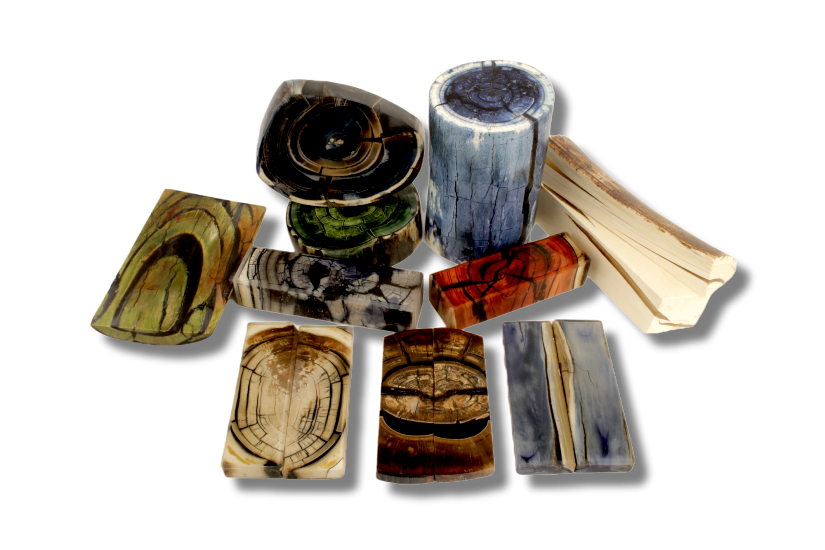
Bark. Natural mammoth bark in every shape, size and colour palette, for makers who want to work with the coloured outer layer of the tusk, from those at the start of their journey to established professionals.
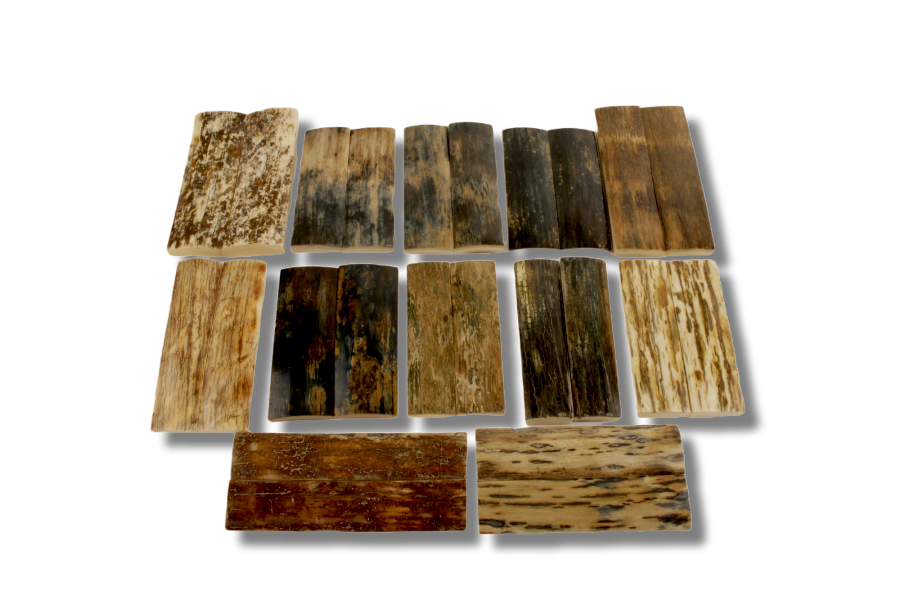
Scales. Natural mammoth ivory scales, sometimes called handles or grips, pre-cut in matching pairs and in a wide range of sizes and colours, for knifemakers, bladesmiths, gunsmiths and other makers.
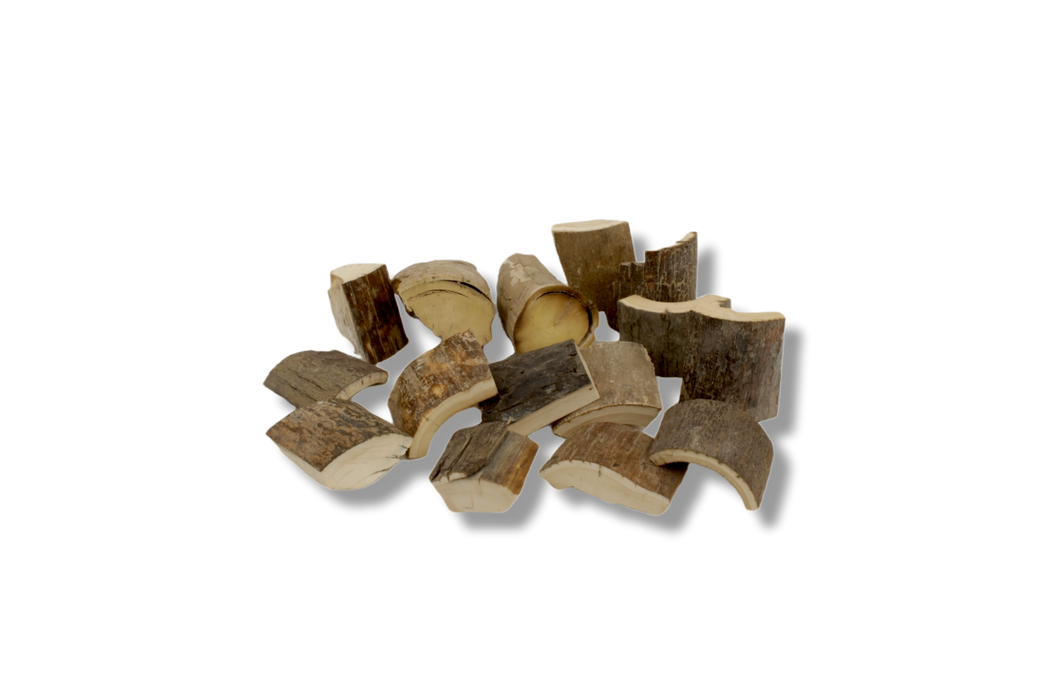
Pieces. Natural mammoth ivory in all shapes and sizes, from large round cross-sections of tusk to semicircular and triangular cuts. Most pieces combine bark and inner ivory.
Segments. Pre-cut, mostly white pieces from the inner core of the tusk, in natural condition and dried for years under controlled temperature conditions: selected for work that calls for predominantly white inner-core material.
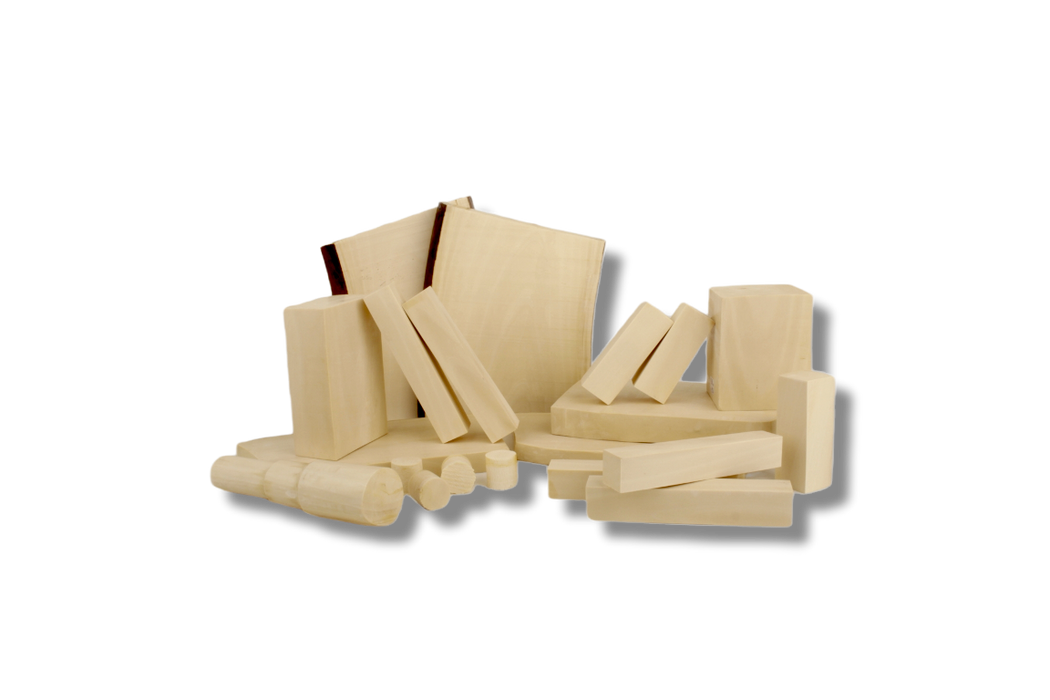
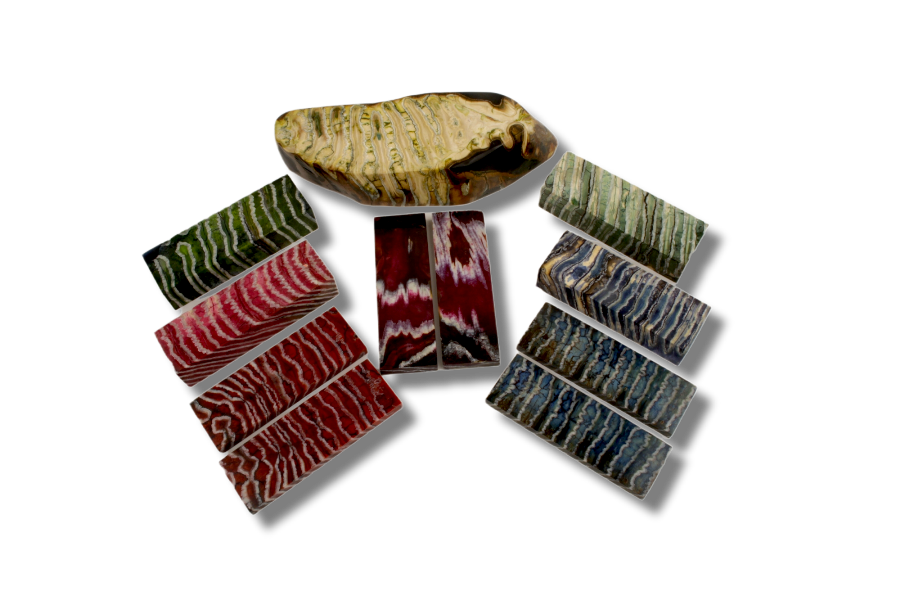
Stabilized Ivory. Professionally stabilised mammoth ivory as pre-cut scales, blocks, tusk sections and white segments, prepared for precision cutting, drilling and polishing.
Mammoth Molars. Whole molars, pre-cut blocks, scales and smaller pieces, all professionally stabilised so that the material can be worked.
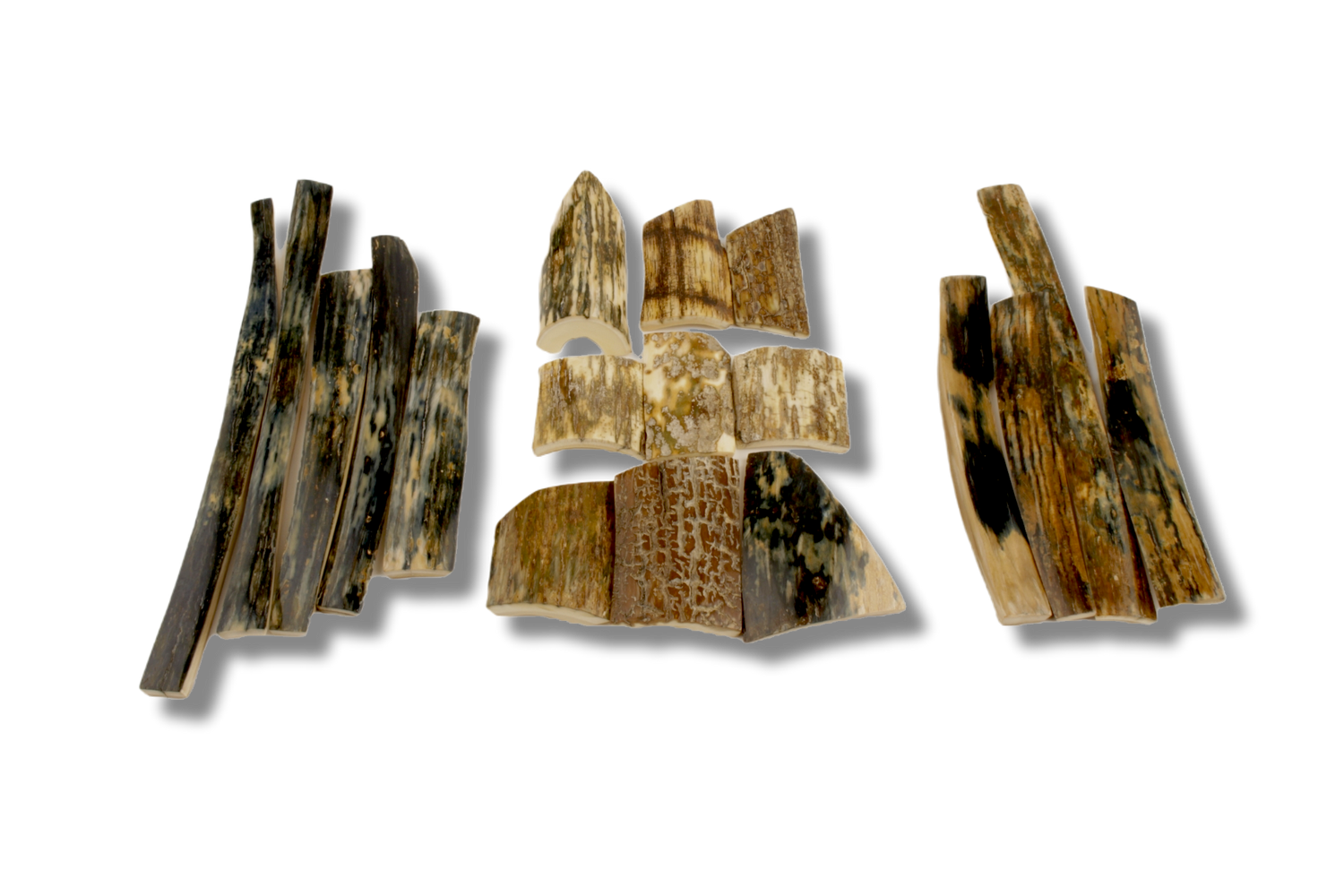
Offcuts. Raw, untreated mammoth ivory offcuts from our workshop, inspected and grouped into matching lots by shape, quality, weight and size. Some combine ivory and bark; others have no bark at all. For anyone who wants to try working with raw mammoth ivory, this is a good place to start.
Bark Offcuts. Natural mammoth bark offcuts, grouped piece by piece into matching lots by colour, shape, quality and weight. Some are completely raw and untreated; most have been cleaned and finished with a transparent layer of wax.
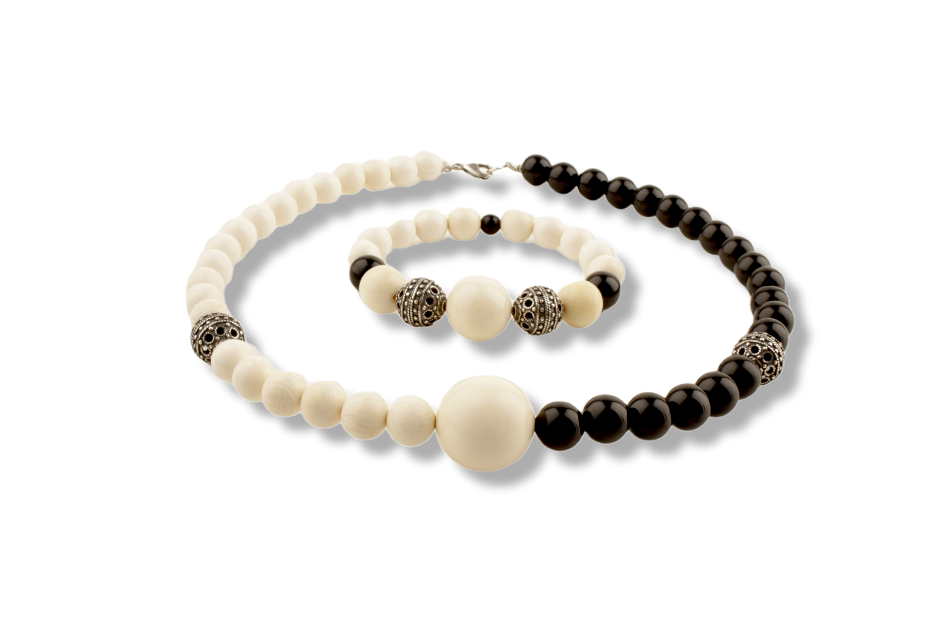
Handcrafted Jewellery. Jewellery designed and made in Germany in small batches, combining mammoth ivory with natural gemstones and silver. Bespoke pieces can be made in collaboration with clients, and we also stock jewellery supplies and components for fellow makers; retailers are welcome to enquire. The material's place in jewellery is described in "Mammoth Ivory in Jewellery," and its care in "Care for Mammoth Ivory Jewellery."
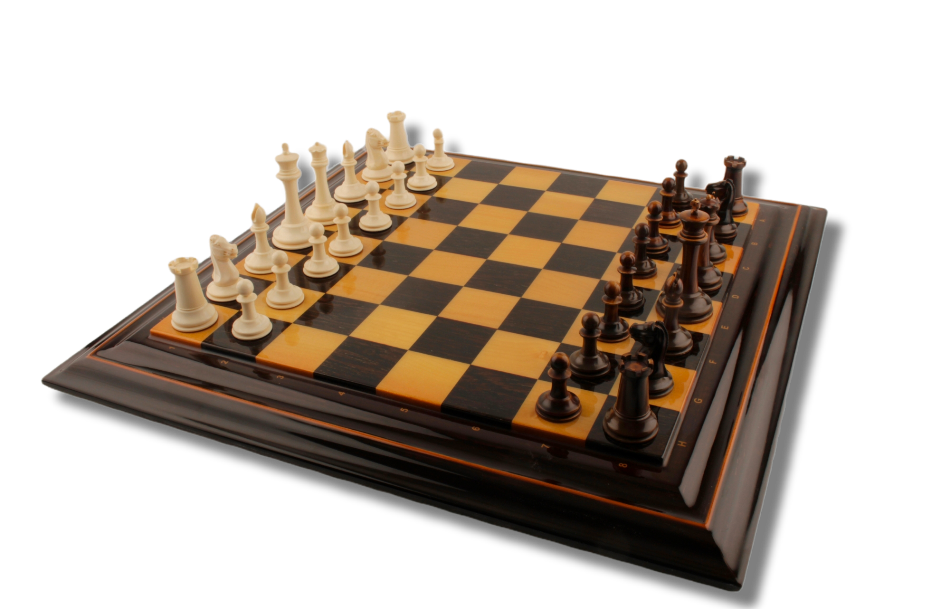
Collection Pieces. Works of art carved from mammoth ivory, chess sets, small tusks and figurines. The category also includes other specimens for fossil collections, among them complete woolly rhinoceros skulls, described in "What Is a Woolly Rhinoceros?"
Documentation
Every large mammoth tusk in our Tusks collection is accompanied by a German Certificate of Origin, issued on our application by the German Chamber of Industry and Commerce (IHK). For all other material, the certificate is available on request and can be added to the shopping cart at checkout. It documents the declared origin of the goods; it is not a scientific authentication of the specimen.
Separately, we hold a Clearance Certificate from the German Federal Agency for Nature Conservation (BfN), Germany's CITES Management Authority, confirming that Mammuthus primigenius is not listed under CITES. It is a company-held document rather than a per-order certificate. How fossil mammoth ivory is sourced and documented, and how the claims of any supplier can be tested, is set out in "The Business of Ethical Mammoth Ivory: Sourcing, Identification and Verification."
Whether it takes the form of a whole tusk, a pair of knife scales or a small offcut, every piece of mammoth ivory comes from an animal that lived during the Ice Age, and is part of a natural material that can never be replenished.
If you have any questions, please email us: info@arcticantiques.com
Bibliography:
CITES Secretariat (2025). Trade in mammoth ivory, SC78 Doc. 65.7, Seventy-eighth meeting of the Standing Committee, Geneva, 3–8 February 2025. (Distribution of woolly mammoth remains in Siberia and the share originating from Yakutia; legal status of mammoth ivory among CITES Parties; Schreger angle thresholds; review of mammoth ivory as a substitute for elephant ivory and the Secretariat's conclusions.)
Espinoza, E. O.; Mann, M.-J. (1991). Identification Guide for Ivory and Ivory Substitutes. World Wildlife Fund and The Conservation Foundation; subsequently published by the CITES Secretariat. (Tusks as modified incisors; structure of proboscidean dental material; Schreger angle thresholds; absence of vivianite colouration in natural elephant ivory.)
Farah, N.; Boyce, J. R. (2019). "Elephants and mammoths: the effect of an imperfect legal substitute on illegal activity". Environment and Development Economics, 24(3): 225–251. DOI: 10.1017/S1355770X18000554. (Effect of Russian mammoth ivory exports on elephant ivory prices and seizures.)
Huang, Z.; Chen, T.; Zheng, J.; Wang, D.; Xu, X. (2023). "Origins of Color in Brown Mammoth Ivory". Gems & Gemology, 59(2). Gemological Institute of America. (Brown as the most common surface colour; iron and manganese minerals crystallised during burial as its cause; recovery from permafrost deposits near rivers and lakes.)
Pfeifer, S. J.; Hartramph, W. L.; Kahlke, R.-D.; Müller, F. A. (2019). "Mammoth ivory was the most suitable osseous raw material for the production of Late Pleistocene big game projectile points". Scientific Reports, 9: 2303. (Composition and mechanical properties of permafrost mammoth ivory compared with modern elephant ivory; use of mammoth ivory by Late Pleistocene societies.)
Shen, M.; Lu, Z.; Xu, Y.; He, X. (2021). "Vivianite and Its Oxidation Products in Mammoth Ivory and Their Implications to the Burial Process". ACS Omega, 6(34): 22284–22291. DOI: 10.1021/acsomega.1c02964. (Vivianite as the cause of blue colouration, forming within the ivory; yellowish-white dentine.)
Vartanyan, S. L.; Garutt, V. E.; Sher, A. V. (1993). "Holocene dwarf mammoths from Wrangel Island in the Siberian Arctic". Nature, 362(6418): 337–340. (Survival of the last woolly mammoths on Wrangel Island until approximately 4,000 years ago, after their extinction on the mainland.)