How to Identify Genuine Mammoth Ivory (and Spot Fakes)
Buyers of fossil mammoth ivory often ask us two questions: how do I know this is really ivory, and how do I know it is really fossil mammoth ivory? Both are fair questions, and they deserve a proper technical answer rather than reassurances.
This guide explains the features that identify genuine fossil mammoth ivory (Mammuthus primigenius), the substitutes and imitations circulating in the market, the tests that work, the tests that do not, and how any buyer can obtain independent scientific confirmation of a specimen at their own initiative.
We should state our own position at the outset. Arctic Antiques GmbH deals exclusively in fossil mammoth ivory recovered from the Siberian permafrost. We do not buy, sell, broker, evaluate, handle or process elephant ivory in any form. We never have and never will. Dealing in elephant ivory runs contrary to our moral principles, regardless of what any regulation might permit.
The following guide is written to help anyone verify material for themselves, including material bought elsewhere.
Two Separate Questions
Most identification guides conflate two questions that are entirely distinct and have to be answered separately:
- Is the material ivory at all? It may instead be bone, antler, horn, tagua nut, resin or plastic.
- If it is ivory, from which animal does it derive? Proboscidean ivory may come from an extinct mammoth or from a living, protected elephant. Other types of ivory come from walrus, hippopotamus, sperm whale, narwhal or warthog.
A piece can pass the first test and fail the second. Any serious examination therefore has to answer both, not just the easier one — and it is the second question that carries the legal and commercial consequences.
Why CITES Does Not Apply to Fossil Mammoth Ivory
CITES — the Convention on International Trade in Endangered Species of Wild Fauna and Flora, otherwise known as the Washington Convention — exists to protect wild animal and plant species that are still living today and threatened by international trade.
The woolly mammoth has been extinct for thousands of years and is listed on no CITES appendix. Fossil mammoth ivory therefore falls outside the Convention entirely: it can be legally traded internationally, and bought, sold and shipped without any CITES permit or certificate.
National and regional law is a separate matter. A small number of US jurisdictions have extended their own ivory legislation to cover ivory of every kind, including certified fossil mammoth ivory such as ours (California, Hawaii, Illinois, Nevada, New Jersey, New York and the District of Columbia). These are local trade bans, unconnected to CITES, and buyers should check what applies where they live before ordering.
Elephant ivory is in an entirely different position. Both the African and the Asian elephant are living species under protection, and trade in their ivory is heavily restricted. The difference between the two materials is therefore not a technicality, and knowing how to tell them apart is what the rest of this guide is about.
Where the Material Comes From
Our fossil mammoth ivory is recovered from the permafrost of northern Siberia, principally the Yakutia region, where woolly mammoths lived in large numbers throughout the Late Pleistocene (approximately 129,000 to 11,700 years ago).
This matters for identification. No elephant species living today has ever inhabited the Arctic tundra. Loxodonta is confined to sub-Saharan Africa. The historical range of the Asian elephant (Elephas maximus) extended from West Asia through the Indian subcontinent and Southeast Asia into China, reaching at its furthest northern extent the Yangtze — still several thousand kilometres south of the Siberian permafrost, and in an entirely different climate. Proboscidean tusk material recovered from Siberian permafrost is mammoth ivory.
Provenance is evidence rather than proof, because it depends on the integrity of the supply chain rather than on the object itself. It is nonetheless the first and most practical filter, and it is the reason documented sourcing carries a premium in this market.
Fossil, But Not Petrified
Mammoth ivory is routinely described in the trade and in the scientific literature as fossil ivory, and this is correct: it is the preserved remains of an animal (Mammuthus primigenius) that has been extinct for thousands of years, and paleontologists study mammoth tusks as fossils.
It is not, however, petrified. In genuinely permineralised fossils the original organic material has been replaced by minerals, leaving stone in the shape of the original object. Permafrost mammoth ivory has not undergone that substitution. Analytical work using X-ray diffraction, infrared spectroscopy and electron microscopy shows that it remains composed principally of hydroxyapatite, carbonate hydroxyapatite and collagen — the same constituents as fresh dentine. Measured directly, mammoth and African elephant dentine contain mineral and organic phases in almost identical proportions, at roughly 59% mineral and 34% protein by mass in both.
Burial does alter the material. Over tens of thousands of years in the Siberian permafrost, some organic matter and phosphate are gradually lost, the hydroxyapatite slowly recrystallises, and fissures open. These changes are most advanced at the outer surface and least advanced in the inner core. Even so, research on the mechanical properties of mammoth tusk dentine has found that its stiffness and fracture toughness can be fully retained after thousands of years in permafrost.
Two practical consequences follow. First, this is why mammoth ivory works like ivory rather than like stone under a saw or a graver (see our article "How to Cut Mammoth Ivory"). Second, and more importantly for this article, it is why scientific dating and molecular analysis are possible at all: there is still original organic material in the specimen to test.
Schreger Lines: The Primary Diagnostic Feature
The single most useful physical test is the Schreger pattern, first described by the German anatomist Bernhard Gottlob Schreger in 1800 and still the standard morphological method used in wildlife forensics.
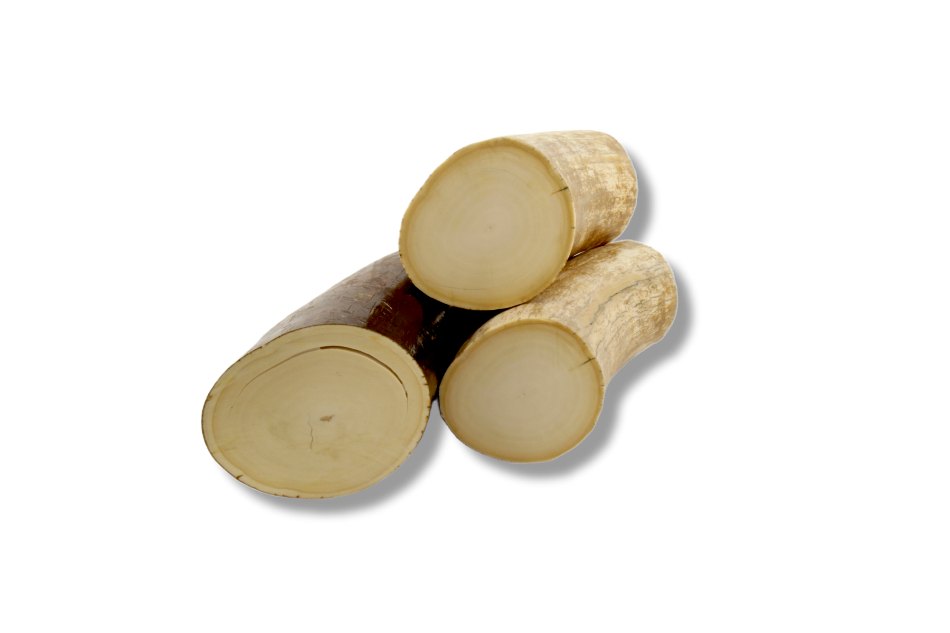
In a transverse (cross-cut) section of any proboscidean tusk, the arrangement of dentinal tubules produces a pattern of intersecting curved lines, variously called cross-hatchings, engine turnings or stacked chevrons. These lines meet to form measurable angles. Two categories exist: the clearly visible outer Schreger angles, closest to the cementum, and the fainter inner angles near the pulp cavity (the centre of a mammoth tusk). Only the outer angles are diagnostic — inner angles overlap substantially between species.
The established thresholds, from the foundational work of Espinoza and Mann, are:
- Mean outer Schreger angles below 90° (acute) indicate extinct proboscideans — mammoth or mastodon.
- Mean outer Schreger angles above 115° (obtuse) indicate modern elephants.
Three caveats are essential, and any guide that omits them is misleading you:
- The intermediate zone is genuinely ambiguous. Both extinct and extant sources can produce outer angles between 90° and 115°. The CITES identification guide states explicitly that differentiation should never be based on a single angle measurement. A recent gemmological study of confirmed mammoth ivory measured outer Schreger angles of 95–105°, squarely within that ambiguous band.
- The cementum-dentine junction must be present. Schreger angles widen from the pulp cavity outward, so a measurement is only meaningful if you know where in the tusk it was taken. A polished fragment cut from an unknown position cannot be assessed reliably.
- The cut orientation must be correct. The pattern appears in transverse section. A longitudinal cut will not display it.
Applied properly, with multiple measurements, the method is powerful: discriminant analysis of Schreger pattern features has been shown to separate mammoth from extant elephant ivory in over 99% of cases. Applied casually to a single polished surface, it can mislead.
Beware Imitation "Engine-Turned" Patterns
This is the point at which most identification advice fails, and it is worth stating plainly: the presence of a cross-hatched pattern does not by itself prove a material is ivory.
The Gemological Institute of America has documented two resin materials sold as imitation ivory, marketed under the names "Arvorin Plus" and "Resin-Ivory+S". Both are manufactured as rods in a range of lengths, and both show fine parallel striations along their length together with a distinct pattern reminiscent of Schreger lines — the effect commonly called engine-turning. One was bought over the counter from a billiard supplier and the other from a guitar shop: precisely the outlets a maker looking for an ivory substitute would use.
Such materials are not necessarily sold dishonestly. But once they enter the second-hand market, stripped of their packaging and description, a buyer relying on pattern alone can be badly misled. What distinguishes genuine ivory is not the presence of a pattern but its natural geometry, its correct relationship to the tusk structure, and its consistency with everything else about the specimen.
Mammoth Bark: The Cementum Layer and Natural Colouration
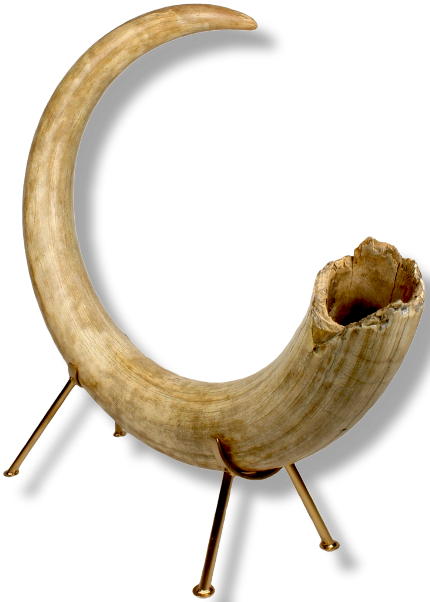
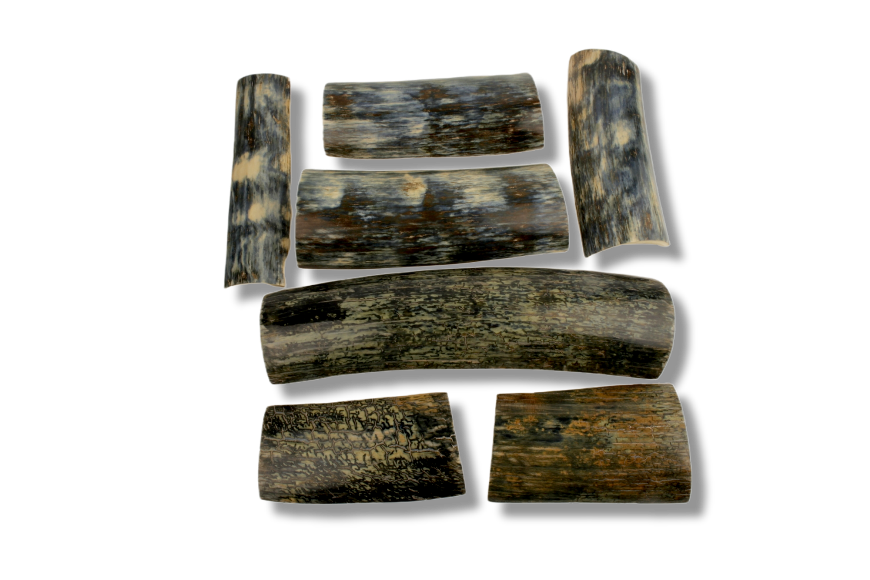
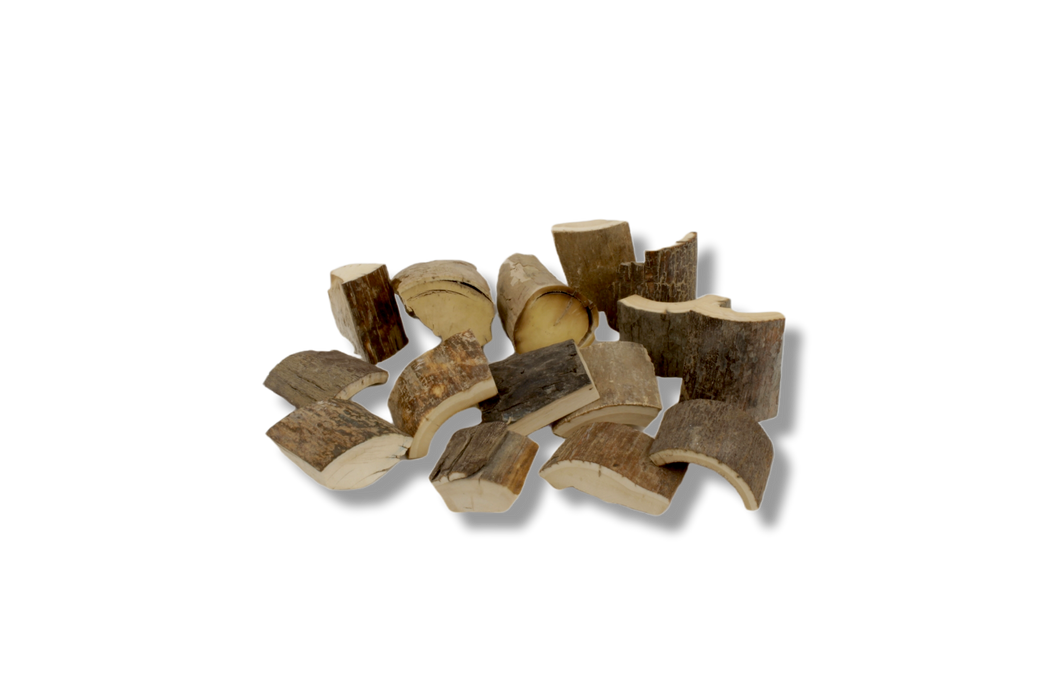
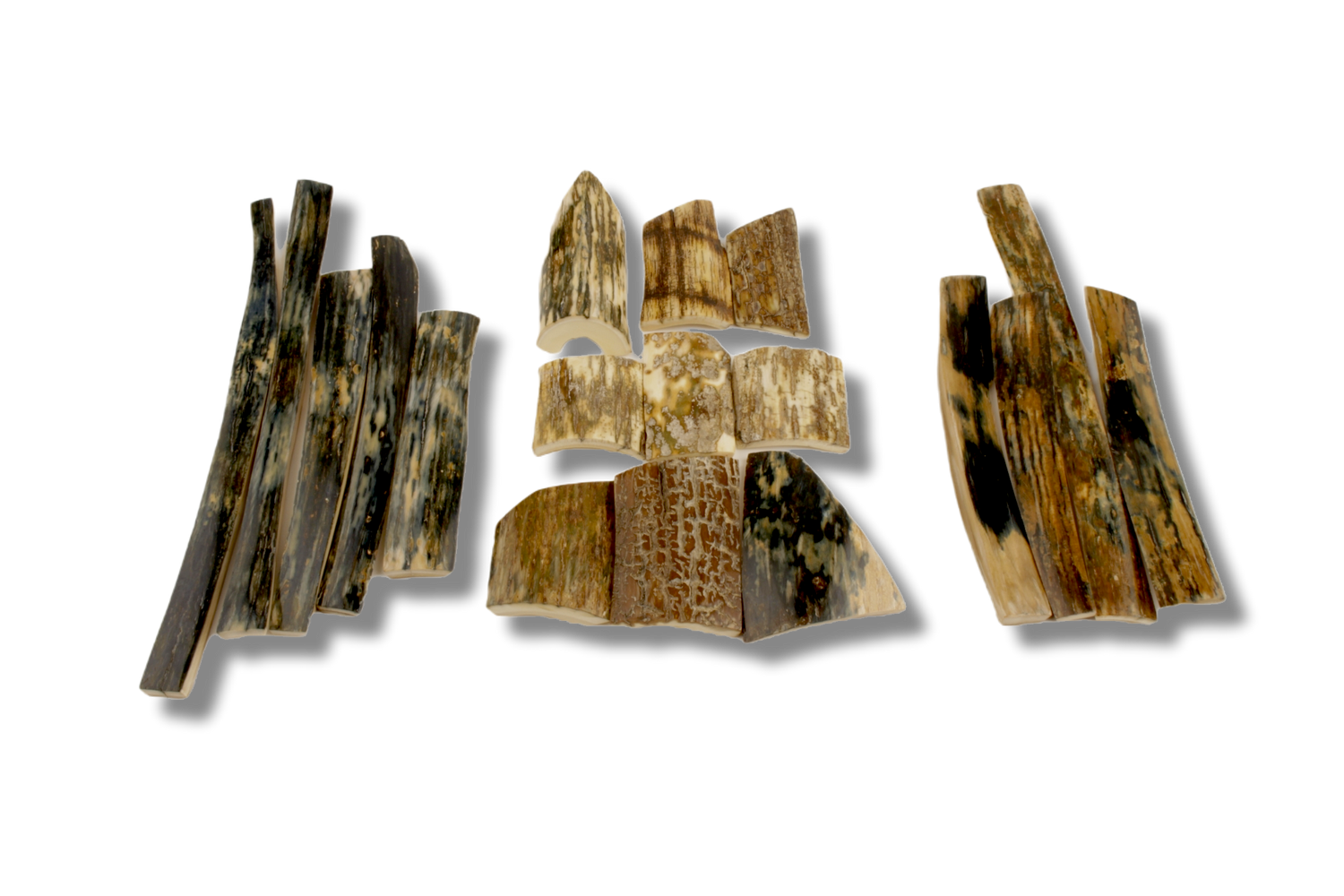
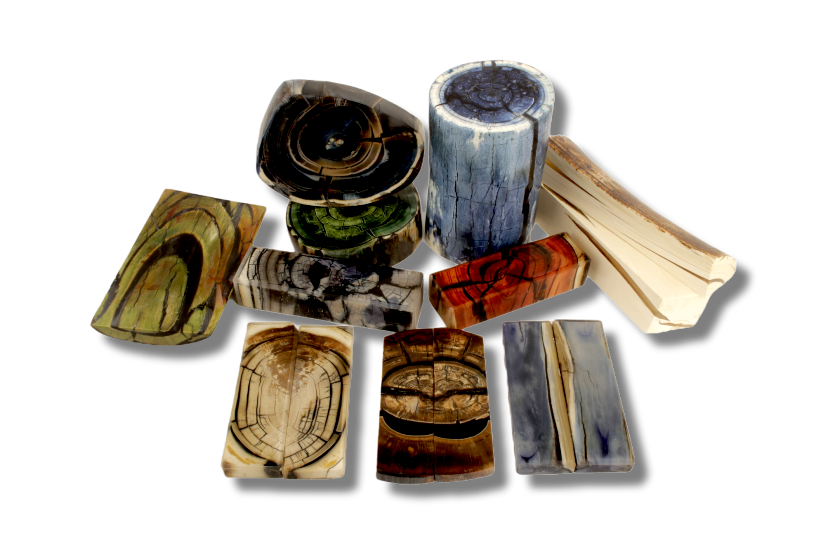
Genuine Siberian mammoth tusks characteristically retain a thick outer cementum layer — what the trade calls mammoth bark. In mammoth ivory this layer is substantially thicker than the equivalent layer on modern elephant ivory, and it is often weathered, fissured and strongly coloured.
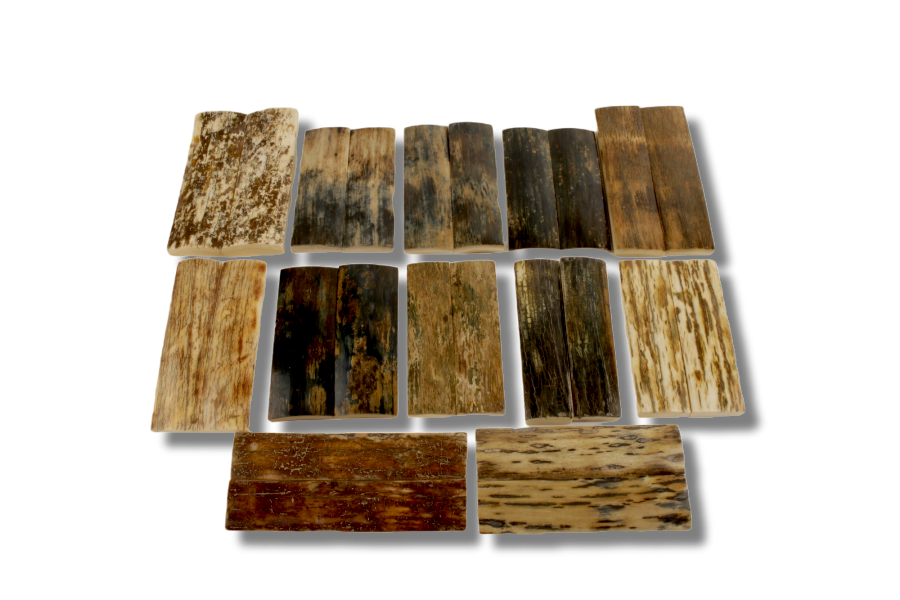
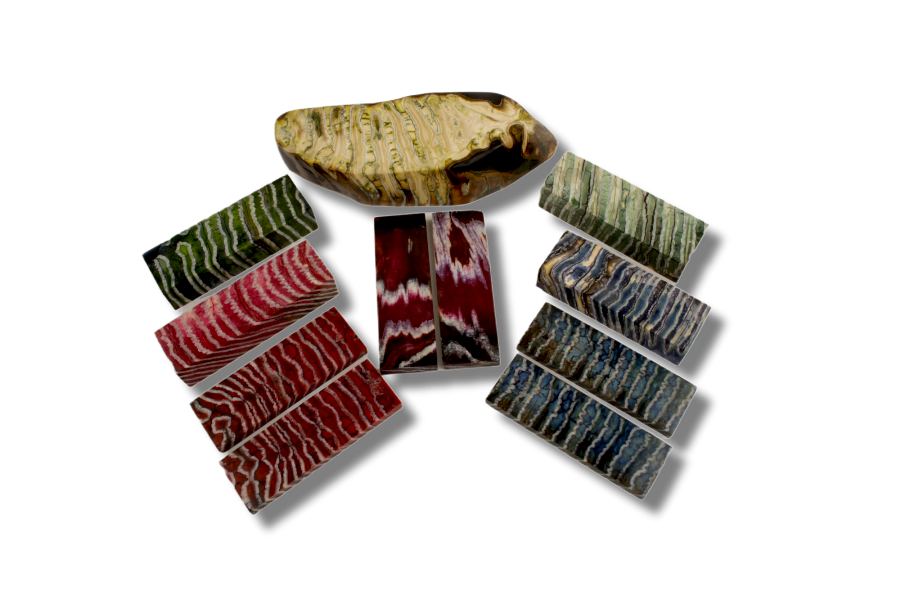
The colours are mineralogically real and have been directly identified by X-ray diffraction and electron microscopy. Brown, tan and reddish tones arise from iron and manganese minerals — hematite, pyrite, pyrolusite and manganite — that crystallised on and within the material during burial. The distinctive blue to blue-green colouration prized by collectors is caused by vivianite, a secondary hydrated iron phosphate. It forms within the tusk itself: iron from the surrounding groundwater migrates into the material and reacts with the phosphate already present in the dentine. As vivianite oxidises it converts progressively to metavivianite and santabarbaraite, which account for the yellowish-brown tones often found alongside the blue. The CITES identification guide records that elephant ivory does not display intrusive vivianite discoloration in its natural state.
This is worth emphasising for buyers who assume that strong colour implies treatment: on genuine fossil mammoth ivory from the Siberian permafrost, dramatic natural colouration is the expected result of tens of thousands of years in mineral-rich frozen ground, not evidence of dyeing. Colour and mineralisation are discussed further in our article "Mammoth Ivory vs Mammoth Bark: What is the Difference?".
One further structural difference is diagnostically useful. In mammoth ivory, organic protein content decreases measurably from the inner dentine outward toward the surface, a gradient produced by burial. Elephant ivory shows almost no such difference between its layers.
Natural Cracks, Fissures and Stabilised Material
Fissuring is normal in fossil mammoth ivory. Cracks form during burial as organic material and phosphate are gradually lost, and further drying occurs after recovery. Their presence is expected and is not a defect in the sense a buyer of new material might assume. Nor does surface fissuring mean the material is weak: as noted above, the mechanical properties of mammoth tusk dentine survive burial in permafrost largely intact, and well-selected, properly dried material remains dense, structurally solid and highly durable — closer in working behaviour to a soft metal than to wood, and capable of taking a variety of different polishes. Fissures are a record of the material's age, not an indication of fragility.
The corollary is that an unnaturally uniform material — no fissures, no mineral variation, perfectly consistent colour throughout a large piece — deserves closer examination rather than less.
It is equally important not to draw the wrong conclusion in the other direction. Professionally stabilised mammoth ivory, in which natural cracks have been consolidated with a special mixture of resin under vacuum, is genuine mammoth ivory that has been treated. Treatment is not falsification, provided it is disclosed. Each piece of our stabilised ivory is explicitly described as such.
Common Substitutes and How They Differ
- Bone is the most plausible inexpensive substitute. It has a fundamentally different internal structure, with a vascular canal system that appears under magnification as fine pores or dark speckling running through the material. It never shows Schreger lines.
- Antler and horn likewise lack Schreger lines and have distinct structures of their own — horn in particular is keratin, not dentine.
- Resin and plastic may be moulded with striations or pseudo-Schreger patterns, but lack genuine dentine microstructure. Moulding artefacts, bubbles and unnaturally regular repetition are typical.
- Tagua nut ("vegetable ivory") is a traditional and honest substitute, easily separated under magnification by its plant cell structure.
- Other animal ivories — walrus, hippopotamus, warthog, narwhal, sperm whale — are true ivories but come from different species with different legal status. Walrus, for example, shows a characteristic mottled secondary dentine core and no Schreger pattern.
These are identification differences rather than quality judgements, but the two are connected. A comparative study of osseous raw materials found that mammoth tusk dentine matches the highest bending strength and work-of-fracture values recorded for reindeer and red deer antler — a material already renowned for exceptional toughness — while narwhal tusk dentine, by comparison, is only about one third as strong. Antler and bone are capable materials in their own right.
Where mammoth ivory is without rival is in the combination. Antler is branched and has a spongy core, so only the thin outer compacta can be worked. Bone is curved, hollow and thin-walled. Horn is layered keratin, tough but not stiff. Mammoth tusk is the only one of these materials that delivers that level of mechanical performance in large, solid, homogeneous pieces — which is why Late Pleistocene hunters chose it over every other osseous material available to them for heavy projectile points. It remains the first choice today for knife scales and fine cutlery, pistol grips and inlaid rifle stocks, components for guitars, violins and pianos, inlay work of every kind, and the restoration of antique furniture.
Tests That Do Not Reliably Work
Several widely repeated tests are weaker than their reputation suggests:
- Weight and feel. Genuine ivory is dense and cool to the touch, and this is useful for initial screening. It is not conclusive: modern imitation materials can be engineered to approximate ivory's physical properties closely.
- Ultraviolet light. Ivory generally shows weak bluish fluorescence. However, mammoth and elephant ivory fluoresce similarly, so UV cannot distinguish between them at all. Worse, fluorescence varies within a single mammoth specimen — the collagen-rich inner dentine fluoresces while heavily fossilised outer surfaces may not. UV is a screening aid for some synthetics, nothing more.
- The hot needle test. We do not recommend it under any circumstances. It is destructive, it can permanently damage a valuable specimen, and it yields far less information than proper visual examination. Do not burn, cut or drill an object to find out what it is.
- Claims of age. "Over 10,000 years old" is a statement about the material, not evidence for it. An age claim in a listing authenticates nothing.
Independent Verification: Radiocarbon Dating
Clients who want certainty beyond visual examination are welcome to have any piece they buy from us independently tested, at their own expense and on their own initiative. We actively support and encourage our bespoke clientele to do exactly that.
Radiocarbon dating is the most decisive option for this particular question. Radiocarbon has known limitations in the ivory trade — it cannot resolve dates between roughly 1650 and 1955 with useful precision — but those limitations are irrelevant here, because the two candidate answers are separated not by decades but by tens of thousands of years:
- Modern elephant ivory contains atmospheric radiocarbon at present-day levels, and material formed after the 1950s carries an elevated "bomb pulse" signature from atmospheric nuclear testing, which allows dating to within a year or two.
- Genuine mammoth ivory is either many tens of thousands of years old or entirely radiocarbon-dead, returning results beyond the method's detection limit of roughly 50,000 years.
There is no overlap and no ambiguity. A published forensic study of ivory samples returning ages greater than 45,000 years concluded simply that the material was certainly mammoth.
In practice, the process is straightforward. The buyer approaches an accredited radiocarbon laboratory directly. Accelerator mass spectrometry (AMS) facilities operate in many countries — across Europe, North America, Asia, Australia and New Zealand among them — and most accept commercial submissions from private clients. The method requires only a very small sample, typically a fraction of a gram, taken discreetly from an inconspicuous area. The laboratory extracts collagen, measures the carbon-14 content, and issues a report. Costs and turnaround times vary by laboratory and are best confirmed directly with them.
What We Do and Do Not Provide
Arctic Antiques does not provide identification, authentication, appraisal or expert-opinion services, whether for our own material or for material acquired elsewhere. We are a specialist fossil mammoth ivory dealer, not an officially designated testing authority, and we do not hold accreditation to issue findings of that kind. Requests to identify third-party objects are declined.
What we do provide with our material is documentation. Our Certificate of Origin is an official document issued on our application by the German Chamber of Industry and Commerce (IHK). It documents the declared origin of the goods; it is not a scientific authentication of the specimen. The Certificate of Origin is automatically included with every large tusk we offer for sale. For all other material it is not issued automatically, but is available to any customer on request and can simply be added to the shopping cart during checkout.
Separately, as a specialist dealer in this material, we hold a Clearance Certificate obtained from the German Federal Agency for Nature Conservation (BfN) — Germany's CITES management authority — confirming that Mammuthus primigenius is not listed under CITES and is therefore not subject to CITES trade controls.
For formal authentication, buyers should approach an accredited gemmological laboratory, a wildlife forensics laboratory, or a radiocarbon dating facility. Alongside radiocarbon dating, the established laboratory methods include Raman spectroscopy, which can separate extinct from living elephantid ivory without damaging the specimen; FTIR spectroscopy, which reliably identifies resin imitations; and DNA analysis of a short sequence of the cytochrome b gene, which assigns material to species.
A Practical Sequence
For anyone examining a piece — ours or anyone else's — the following order is sensible:
- Establish the stated provenance and ask for official documentation.
- Examine the outer surface and cementum layer where present.
- Look for natural mineralisation, colour variation and fissuring consistent with burial.
- Find or request a transverse cross-section.
- Examine the Schreger pattern, noting where in the tusk the section was taken.
- Take multiple outer angle measurements rather than one.
- Look for signs of manufacture: mould lines, bubbles, unnatural regularity.
- Use magnification to check for dentine structure rather than bone porosity or plant cells.
- For valuable, disputed or heavily worked material, commission laboratory analysis.
No Single Feature Is Conclusive
This is the most important point. A sophisticated imitation can reproduce colour, surface texture, cracking and even a plausible engine-turned pattern. Conversely, genuine mammoth ivory varies enormously in appearance depending on burial conditions, degree of mineralisation, and position within the tusk — a small polished jewellery component may display almost none of the obvious characteristics of a raw tusk.
Reliable identification therefore comes from the convergence of several independent lines of evidence: structure, Schreger geometry, mineralisation, provenance and documentation, supported by laboratory analysis where the value or the uncertainty justifies it.
Preserving the Craft and the Material
There is also a wider argument for buying documented mammoth ivory from a specialist. The craft traditions built around ivory over centuries depend on a material that living elephants can no longer be asked to supply — scrimshaw, netsuke, inlay, fine cutlery, knife scales, gun grips, components for musical instruments, and the restoration of antiques and historic instruments.
Fossil mammoth ivory allows those traditional skills to continue, and to be passed on. The valuable material comes from an animal that has been extinct for thousands of years, so no living creature is involved at any stage. And because the supply is finite and can never be renewed, every piece of mammoth ivory that is carefully recovered, properly prepared and officially documented is a fragment of the Ice Age preserved rather than lost. The handcrafted objects made from it are meant to be kept, cared for, and handed on to the next generations.
If you have any questions, please email us: info@arcticantiques.com
Bibliography:
Espinoza, E. O.; Mann, M.-J. (1993). "The History and Significance of the Schreger Pattern in Proboscidean Ivory Characterization". Journal of the American Institute for Conservation, 32(3): 241–248.
Espinoza, E. O.; Mann, M.-J. (1991). Identification Guide for Ivory and Ivory Substitutes. World Wildlife Fund and The Conservation Foundation; subsequently published by the CITES Secretariat.
District of Columbia. Ivory and Horn Trafficking Prohibition Act of 2020, D.C. Law 23-126, § 2 (defining "ivory" to include the tooth or tusk of any species of elephant, hippopotamus, mammoth, mastodon, narwhal or whale). Official Code of the District of Columbia.
California Fish and Game Code § 2022; Hawaii Revised Statutes § 183D-66(d) ("No person shall sell, offer to sell, purchase, trade, possess with intent to sell, or barter for any part or product from mammoth (Mammuthus), although the species is extinct"); 815 Illinois Compiled Statutes § 357; Nevada Revised Statutes § 597.905; New Jersey Revised Statutes § 23:2A-13.1 to 13.5; New York Environmental Conservation Law § 11-0535-a — state statutes expressly extending to mammoth ivory.
New York City Bar Association (2025). Report on How Mammoth Ivory Contributes to Elephant Poaching.
Trapani, J.; Fisher, D. C. (2003). "Discriminating Proboscidean Taxa Using Features of the Schreger Pattern in Tusk Dentin". Journal of Archaeological Science, 30(4): 429–438.
Huang, Z.; Chen, T.; Zheng, J.; Wang, D.; Xu, X. (2023). "Origins of Color in Brown Mammoth Ivory". Gems & Gemology, 59(2).
"Vivianite and Its Oxidation Products in Mammoth Ivory and Their Implications to the Burial Process" (2021). ACS Omega. DOI: 10.1021/acsomega.1c02964.
Yin, Z.; Zhang, P.; Chen, Q.; Zheng, C.; Li, Y. (2013). "A Comparison of Modern and Fossil Ivories Using Multiple Techniques". Gems & Gemology, 49(1).
Gemological Institute of America (2019). "Resin Imitation Ivory with a Pseudo 'Engine-Turned' Structure". Gems & Gemology Lab Notes, 55(3).
Quarta, G.; Calcagnile, L.; Giffoni, M.; Braione, E.; D'Elia, M. (2019). "Radiocarbon dating of ivory: Potentialities and limitations in forensics". Forensic Science International, 299: 114–118.
Uno, K. T.; Quade, J.; Fisher, D. C.; Wittemyer, G.; Douglas-Hamilton, I.; Andanje, S.; Omondi, P.; Litoroh, M.; Cerling, T. E. (2013). "Bomb-curve radiocarbon measurement of recent biologic tissues and applications to wildlife forensics and stable isotope (paleo)ecology". Proceedings of the National Academy of Sciences, 110(29): 11736–11741.
Shepherd, R. F.; Lister, A. M.; Roberts, A. M.; Taylor, A. M.; Kerns, J. G. (2024). "Discrimination of ivory from extant and extinct elephant species using Raman spectroscopy: A potential non-destructive technique for combating illegal wildlife trade". PLOS ONE, 19(4): e0299689.
Ngatia, J. N.; Lan, T. M.; Ma, Y.; Dinh, T. D.; Wang, Z.; Dahmer, T. D.; Xu, Y. C. (2019). "Distinguishing extant elephants ivory from mammoth ivory using a short sequence of cytochrome b gene". Scientific Reports, 9: 18863.
Cartier, L. E.; et al. (2020). "A Case Study of Ivory Species Identification Using a Combination of Morphological, Gemmological and Genetic Methods". The Journal of Gemmology, 37(3): 282–294.
Pfeifer, S. J.; Hartramph, W. L.; Kahlke, R.-D.; Müller, F. A. (2019). "Mammoth ivory was the most suitable osseous raw material for the production of Late Pleistocene big game projectile points". Scientific Reports, 9: 2303.
Sukumar, R. (2003). The Living Elephants: Evolutionary Ecology, Behaviour and Conservation. Oxford University Press. (Historical and present distribution of Elephas maximus; the reference relied upon by the IUCN Red List assessment for the species.)
Lister, A. M.; Sher, A. V.; van Essen, H.; Wei, G. (2005). "The pattern and process of mammoth evolution in Eurasia". Quaternary International, 126–128: 49–64.
International Commission on Stratigraphy. International Chronostratigraphic Chart. (Defines the Late Pleistocene, or Tarantian stage, as 129,000 ± 1,000 to 11,700 years before present.)