What Is a Woolly Rhinoceros?
The woolly rhinoceros (scientific name: Coelodonta antiquitatis) was a heavily built, cold-adapted rhinoceros that ranged across northern Eurasia for more than 400,000 years, through a succession of glacial cycles, before dying out around 14,000 years ago. It was the second-largest land mammal of the mammoth steppe after the woolly mammoth, and the longest rhinoceros horn ever recorded belongs to this species. Its skulls are among the most striking objects to emerge from the Siberian permafrost.
A Rhinoceros Built for the Ice Age
Imagine the mammoth steppe at the height of the last glaciation: a dry, treeless grassland running from the Atlantic coast of Europe to the Bering Sea, the northernmost arm of the Pacific lying between north-eastern Siberia and Alaska, with cold clear winters, thin snow cover and firm ground underfoot. This landscape carried an extraordinary weight of large herbivores — mammoth, steppe bison, wild horse, reindeer, saiga antelope — and among them moved an animal that looked, at a distance, like a large, low dark boulder working its way slowly across the grass.
The woolly rhinoceros stood roughly 1.45–1.60 m at the withers (about 4 ft 9 in to 5 ft 3 in), measured 3.2–3.6 m from head to tail (10.5–11.8 ft), and weighed in the region of 1.5–2 tonnes (3,300–4,400 lb), with some estimates placing large individuals higher still. That made it broadly comparable in bulk to the living white rhinoceros, though quite different in proportion: the woolly rhinoceros had a longer body and markedly shorter legs. Its head was carried low and slung forward, held by powerful muscles anchored to a long, sloping occiput.
Almost every feature of the animal was a response to cold. A dense woolly undercoat lay beneath long, coarse guard hairs that were thickest over the neck and withers, while the legs carried short hair that stopped snow and ice from clinging and hampering movement. The skin was 5 to 15 mm thick (0.2–0.6 in), thinnest on the sides of the head and heaviest across the chest, back and hindquarters, with a layer of subcutaneous fat beneath it. The ears reached only 18.5–24 cm (7.3–9.4 in), against 25–30 cm (9.8–11.8 in) in a female white rhinoceros, and the tail was about 50 cm (19.7 in) rather than the 70–75 cm (27.6–29.5 in) typical of living rhinos. Shortened extremities of exactly this kind are seen again and again in cold-climate mammals, and the woolly mammoth shows the same pattern.
One long-standing question was settled only recently. Palaeolithic cave artists consistently drew woolly rhinoceroses with a pronounced hump over the shoulders, but no mummified specimen had ever shown one, and the hump was widely dismissed as artistic licence. Then, in 2020, a mummy of a four-year-old animal was recovered from the bank of the Tirekhtyakh River in Yakutia with the hump plainly present — a fat deposit roughly 40 cm (15.7 in) long sitting between the back of the skull and the tops of the shoulder blades. The artists had been right.
Out of Tibet
The woolly rhinoceros did not acquire its cold adaptations because the Ice Age arrived. It arrived with them already in place.
In 2007 a complete skull and lower jaw were recovered from the Zanda Basin in south-western Tibet and described as a new species, Coelodonta thibetana, dating to roughly 3.7 million years ago — well before the onset of the Pleistocene glaciations. This animal already showed the flattened nasal horn and the low, grazing-adapted skull of its later relatives. The finding gave rise to the "out of Tibet" hypothesis: that the cold winters of the high plateau served as a training ground for a suite of Ice Age megaherbivores, which were pre-adapted and ready to expand across Eurasia once the climate cooled.
The genus spread through Siberia, Mongolia and China during the Early Pleistocene. Coelodonta antiquitatis itself first appears in China in the early Middle Pleistocene, and the oldest European remains of the species date to around 450,000 years ago. The genus reached Europe earlier still: a Coelodonta skull from Bad Frankenhausen in Germany comes from cold-stage deposits roughly 460,000 years old. Across this lineage the skull became progressively longer, narrower and more steeply inclined, the tooth rows shifted, and the enamel and cementum thickened. Every one of these changes made the animal a better grazer.
Its closest living relative, on genomic evidence, is the Sumatran rhinoceros, from which its ancestors diverged around 9.4 million years ago.
Where They Lived
Through those hundreds of millennia its range, at its greatest extent, formed a broad band from northern Spain and Britain in the west, across central and eastern Europe, to north-eastern Siberia, northern China and Mongolia. No other rhinoceros species, living or extinct, has ever occupied so much ground.
It was nonetheless a particular animal about where it would live. It favoured lowlands, plateaus and river valleys with dry climates, firm ground and light snow, and it was absent from Ireland, much of southern Europe, northern Scandinavia, the Taimyr Peninsula and the Japanese islands. Most tellingly, it never crossed into North America — despite being present on the Chukotka Peninsula and Wrangel Island, within a few hundred kilometres of the Bering Land Bridge, over tens of thousands of years when the bridge stood above sea level. The most likely explanation is that the land bridge was too wet and boggy for a short-legged, heavy-bodied animal without spreading hooves or foot pads. Woolly mammoth, cave lion, muskox and steppe bison all made the crossing. The rhinoceros did not.
Horns Unlike Any Living Rhinoceros
Rhinoceros horn has no bony core. It is a skin derivative, built from keratin filaments set in a keratin matrix and attached to the nasal and frontal bones by connective tissue and ligaments — closer in nature to a hoof or a fingernail than to the horn of a bull.
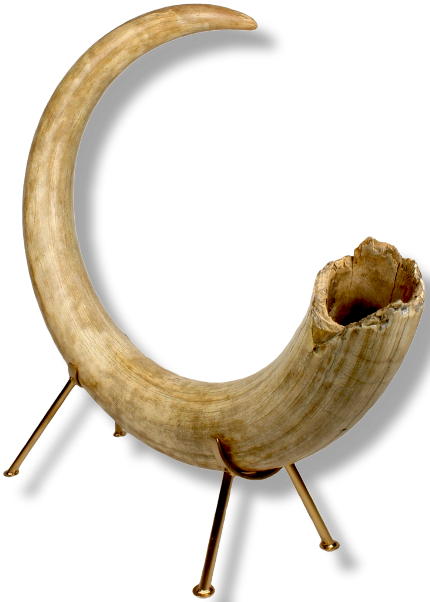
The woolly rhinoceros carried two: a large nasal horn at the front of the skull and a much smaller frontal horn between the eyes. The nasal horn was flattened from side to side and swept back in a long sabre-like arc, a shape with no parallel among the five living rhinoceros species, whose horns are round in cross-section. A recent study of 47 adult nasal horns from the Yakutian permafrost found lengths along the front curve ranging from 68.5 to 134 cm (27 to 52.8 in), averaging 101.7 cm (40 in) — roughly twice the average front horn of a white rhinoceros — with masses between 2.5 and 11.4 kg (5.5–25.1 lb) and an average just above 6 kg (13.2 lb).
In 2024 a horn was recovered on the Mustur-Yuryuye River in Yakutia measuring 164.7 cm (64.8 in) along the anterior curvature and weighing around 9 kg (19.8 lb). It is the longest rhinoceros horn ever recorded, exceeding the previous Coelodonta record by 30.7 cm (12.1 in) and the best-documented modern white rhinoceros horn by 6.6 cm (2.6 in). The accompanying skull was comparatively small, suggesting the animal was female. Associated material dated to roughly 19,700 years ago.
These horns were working tools as much as weapons. They carry paired wear facets on the left and right faces, produced by a side-to-side sweeping motion — almost certainly used to clear thin snow from grazing or to free vegetation frozen to the ground. Skulls also show injuries inflicted by the front horns of other rhinoceroses, and one of the Chauvet Cave paintings depicts two animals facing each other with horns locked.
The frontal horn was a far more modest structure. The best-documented examples run to around 40 cm (15.7 in), with the largest recorded at 47.5 cm (18.7 in).
The skull carries a second unusual feature. In adults — most commonly in males — the nasal septum was ossified, turned to bone, which no living rhinoceros shows. It is generally interpreted as bracing for the face against the loading generated when the horn worked against frozen ground. This is the origin of the old synonym tichorhinus, from the Greek for "walled nose".
Diet, Growth and Lifespan
The woolly rhinoceros was a grazer. Its teeth were high-crowned, thickly enamelled and packed with cementum, well suited to abrasive, silica-rich grasses and the grit taken in with them; adults had no incisors, and the broad upper lip resembled that of the white rhinoceros, allowing it to crop vegetation directly from the ground.
Stomach contents give the diet directly. In the Kolyma mummy, grass pollen made up 46% of the sample and sagebrush (Artemisia) 41%, with a rich variety of other herbs. Material recovered from the Khalbui and Churapcha specimens shows the same dominance of grasses and low herbs. Stable isotope work on horn banding suggests the diet shifted with the seasons, with more woody and shrubby material taken in winter.
Growth was reconstructed from juvenile jaws and limb bones. A one-month-old calf stood about 72 cm (28.3 in) at the shoulder and measured around 120 cm (47.2 in) long. Growth was fastest at three to four years, by which point shoulder height reached about 1.3 m (4 ft 3 in); animals became young adults at seven to ten years at 1.4–1.5 m (4 ft 7 in to 4 ft 11 in), and were fully mature beyond fourteen years at around 1.6 m (5 ft 3 in). Females had two teats, indicating a single calf — occasionally two — as in living rhinos.
Lifespan is read directly from the horn, which grows in annual bands of lighter, denser keratin alternating with darker, looser keratin. These bands correspond closely to the annual layers laid down in dental cementum, which makes them a reliable ageing structure. The record horn from Mustur-Yuryuye carries 40 to 41 annual layers, indicating an animal that lived past forty years — matching the greatest ages recorded for modern rhinoceroses in captivity. Adults had few predators; calves and juveniles were taken by cave lions and cave hyenas.
Humans and the Woolly Rhinoceros
Around twenty Palaeolithic depictions of woolly rhinoceros were known before Chauvet Cave was discovered in southern France, where 65 further paintings and engravings came to light. The animal also appears at Rouffignac, Lascaux and Font-de-Gaume, in red pigment at Kapova Cave in the Urals, and on portable slate engravings from Gönnersdorf in Germany. The images are consistent and recognisable: the low head, the raised back, the long forward-curving horn, and in many cases a dark band across the flank.
Direct evidence of hunting is thinner than the artwork might suggest. For the period after 20,000 years ago the species appears in fewer than 11% of Siberian archaeological faunal assemblages, and it was clearly not a staple prey animal. Where the rhinoceros did enter human life it was often as raw material: half-metre spear throwers made from woolly rhinoceros horn were recovered from the Yana site in Arctic Siberia, dating to around 27,000 years ago, and a 13,300-year-old spear tipped with rhinoceros horn from Bolshoy Lyakhovsky Island remains the furthest north any human artefact has been found.
When Did the Woolly Rhinoceros Go Extinct?
The species was widespread until roughly 35,000 years ago, after which its range contracted steadily eastward. It disappeared from Britain around 35,000 years ago and from western and central Europe in the interval between roughly 17,000 and 15,000 years ago. The youngest well-supported radiocarbon dates come from the Urals at roughly 14,900 years ago and from the Lena–Amga region of north-eastern Siberia at close to 14,000 years ago.
The conventional reading places extinction at around 14,000 years ago, at or near the onset of the Allerød warming. That interstadial was significantly warmer than any event of the previous fifty millennia, and it brought heavier precipitation — including snowfall — along with the replacement of low herbaceous vegetation by shrubs and trees. For a short-legged grazer dependent on open ground and thin snow, both changes were serious.
Two more recent lines of work complicate the picture rather than replacing it. Genomic analysis published in 2020 found the north-eastern Siberian population still large, stable and genetically diverse only a few thousand years before it vanished, which argues against a long decline driven by hunting; the same study identified cold-adaptation variants shared with the woolly mammoth. Separately, a 2024 modelling study using several hundred dated fossils together with ancient DNA concluded that climate-driven habitat fragmentation combined with low but persistent human hunting — on the order of 10% of the population per generation — trapped surviving groups in isolated, poor-quality habitat, with final extinction in north-eastern Siberia as late as around 8,700 years ago. Environmental DNA recovered from Kolyma sediments dating to about 9,800 years ago points in the same direction, though whether that material could have been reworked from older layers remains debated.
As with the woolly mammoth, there is no single settled scientific verdict.
Why the Skulls Survive
Woolly rhinoceros remains reach us for the same reason mammoth ivory does: Siberian permafrost. Ground that stays at or below 0 °C (32 °F) year after year, with cold and low-oxygen conditions, preserves organic material for tens of thousands of years. Each summer the surface layer thaws and releases what it holds, and placer mining and river erosion expose a great deal more.
Even so, the material is scarce. Woolly rhinoceros remains are markedly less common than mammoth remains, and complete, well-preserved skulls with the matching lower jaw are rarer still. Original horns are rarer again — because they are keratin rather than bone, they detach easily from the skull and decompose readily, and they survive almost exclusively in the deepest permafrost of northern Yakutia and western Chukotka. A skull recovered with both original horns still in place is a museum-grade event, not a commercial one.
Our Woolly Rhinoceros Skulls
We offer a small number of woolly rhinoceros skulls within our Collection Pieces. Every skull we sell is natural, and we offer only complete pieces: the upper skull together with its matching lower jaw. We do not sell mismatched or made-up assemblies.
Each piece is inspected thoroughly before it is accepted, then cleaned, dried over a long period and prepared entirely by hand. This is slow, painstaking work, and there is no shortcut for it. The result meets the same standard as everything else we offer.
No restoration work is carried out on our skulls. There are no composites, no epoxy fillers and no reconstructed sections. Where an original tooth has worked loose in its socket, we glue it back into place, since a loose tooth will in time fall out and break; the teeth are always the animal's own, and nothing is added or replaced. The only other intervention is the horn mounting described below, which is not visible to the naked eye.
Both horns are museum-quality replicas, cast from original woolly rhinoceros horns and hand-painted to match the colour of the originals. Given how rarely original keratin horns survive, this is the only honest way to present a complete animal, and we say so plainly. The replicas are held in place by strong magnets, with two magnets set into the upper skull. Magnetic mounting is considerably better than glue or mechanical fixings: it holds the horns securely in display position, yet allows them to be lifted off in seconds for safe transport or relocation. Nothing is bonded, and nothing has to be broken to move the piece.
Every stand is custom-made for the individual skull. Each is fabricated in steel and powder-coated in a deep black finish, so the mount stays quiet and the skull carries the room.
No two skulls are alike. Each animal grew, fed, fought and aged differently, and the skull records it — in proportion, in colour, in surface texture and in the wear on the teeth. That individuality is precisely what makes these pieces compelling for bespoke fossil collections, for interior design projects and for anyone who wants an object with a genuine biography rather than a decorative one.
How to Display a Woolly Rhinoceros Skull
Our skulls are maintenance-free. They ask for the same conditions as a mammoth tusk: a normal, heated interior at ordinary room temperature, kept reasonably stable. Nothing needs to be applied to the bone — no oils, waxes, polishes or cleaning products. Dust with a soft dry brush or a dry cotton cloth and leave the surface alone otherwise.
What matters most is stability rather than any precise figure. Subfossil bone is hygroscopic: it takes up and gives off moisture as the surrounding air changes, and it is repeated swings, not the absolute level, that cause stress. Museum practice for collections of this kind generally works to a relative humidity in the range of 40–60%, avoiding sharp movements within any 24-hour period; conservation guidance specifically for subfossil bone tends to favour the narrower band of 45–55% at around 18–22 °C (65–72 °F). A normally heated, normally ventilated living or working space will usually sit close enough to this without any intervention.
In practice, the positions to avoid are the obvious ones. Keep the piece away from direct sunlight, from radiators and heating outlets, from open fireplaces, and from unheated or damp spaces such as cellars, garages and uninsulated outbuildings. Sustained humidity much above 65% invites mould; sustained dryness well below 40% encourages shrinkage and surface cracking. If a skull is lit deliberately, LED sources are preferable, since they add very little heat.
When moving a piece, lift the horns off first — this is exactly what the magnetic mounting is for — and handle the skull by its stand or by the solid mass of the braincase and jaw, never by the delicate zygomatic arches or the nasal region. A woolly rhinoceros skull is substantial, and it deserves a plinth or surface that will carry it comfortably and a position that is out of the way of general traffic. Beyond that, it will look after itself.
A Survivor of a Vanished World
A woolly rhinoceros skull is the head of an animal that grazed a grassland which no longer exists anywhere on Earth, alongside mammoths and cave lions, at a time when the ice sheets reached into central Europe. It is one of the few objects that can put that world on a table in front of you.
If you have any further questions or require further explanations, please email us: info@arcticantiques.com
Bibliography
Boeskorov, G. G., Lazarev, P. A., Sher, A. V., Davydov, S. P., Bakulina, N. T., Shchelchkova, M. V., Binladen, J., Willerslev, E., Buigues, B., & Tikhonov, A. N. (2011). "Woolly rhino discovery in the lower Kolyma River." Quaternary Science Reviews, 30(17–18), 2262–2272. [Body dimensions and mass; skin thickness; ear and tail length; horn measurements; stomach contents; two teats]
Boeskorov, G. G., Cheprasov, M. Yu., Novgorodov, G. P., Shchelchkova, M. V., Prilepskaya, N. E., & Belyaev, R. I. (2025). "The longest known rhino horn from the permafrost of Yakutia offers insights into woolly rhinoceros morphology, palaeoecology and sexual dimorphism." Journal of Zoology. [Sample of 47 nasal horns; horn length and mass ranges; the 164.7 cm record horn; annual banding and maximum recorded age]
Boeskorov, G. G., Shchelchkova, M. V., Protopopov, A. V., Kryukova, N. V., & Belyaev, R. I. (2024). "Reshaping a woolly rhinoceros: Discovery of a fat hump on its back." Quaternary Science Reviews, 345, 109013. [The Abyi mummy and the first physical confirmation of the shoulder hump]
Boeskorov, G. G. (2012). "Some specific morphological and ecological features of the fossil woolly rhinoceros (Coelodonta antiquitatis Blumenbach 1799)." Biology Bulletin, 39(8), 692–707. [Coat structure; habitat preference; general morphology]
Stuart, A. J., & Lister, A. M. (2012). "Extinction chronology of the woolly rhinoceros Coelodonta antiquitatis in the context of late Quaternary megafaunal extinctions in northern Eurasia." Quaternary Science Reviews, 51, 1–17. [Range and range contraction; radiocarbon chronology; extinction c. 14 ka; absence from North America; horn wear facets; cave art]
Deng, T., Wang, X., Fortelius, M., Li, Q., Wang, Y., Tseng, Z. J., Takeuchi, G. T., Saylor, J. E., Säilä, L. K., & Xie, G. (2011). "Out of Tibet: Pliocene Woolly Rhino Suggests High-Plateau Origin of Ice Age Megaherbivores." Science, 333(6047), 1285–1288. [Coelodonta thibetana; the "out of Tibet" hypothesis]
Kahlke, R.-D., & Lacombat, F. (2008). "The earliest immigration of woolly rhinoceros (Coelodonta tologoijensis, Rhinocerotidae, Mammalia) into Europe and its adaptive evolution in Palaearctic cold stage mammal faunas." Quaternary Science Reviews, 27(21–22), 1951–1961. [Arrival in Europe; evolutionary trends in the skull and dentition]
Lord, E., Dussex, N., Kierczak, M., et al. (2020). "Pre-extinction Demographic Stability and Genomic Signatures of Adaptation in the Woolly Rhinoceros." Current Biology, 30(19), 3871–3879. [Population stability before extinction; cold-adaptation variants shared with woolly mammoth]
Fordham, D. A., Brown, S. C., Canteri, E., et al. (2024). "52,000 years of woolly rhinoceros population dynamics reveal extinction mechanisms." Proceedings of the National Academy of Sciences, 121(24), e2316419121. [Metapopulation modelling; sustained low-level hunting; later Holocene extinction estimate]
Wang, Y., Pedersen, M. W., Alsos, I. G., et al. (2021). "Late Quaternary dynamics of Arctic biota from ancient environmental genomics." Nature, 600(7887), 86–92. [Environmental DNA from Kolyma sediments dated to c. 9,800 years ago]
Liu, S., Westbury, M. V., Dussex, N., et al. (2021). "Ancient and modern genomes unravel the evolutionary history of the rhinoceros family." Cell, 184(19), 4874–4885. [Divergence from the Sumatran rhinoceros lineage]
Fortelius, M. (1983). "The morphology and paleobiological significance of the horns of Coelodonta antiquitatis (Mammalia: Rhinocerotidae)." Journal of Vertebrate Paleontology, 3(2), 125–135. [Horn morphology, wear facets and annual banding]
Belyaev, R. I., Boeskorov, G. G., Cheprasov, M. Yu., & Prilepskaya, N. E. (2023). "A new discovery in the permafrost of Yakutia sheds light on the nasal horn morphology of the woolly rhinoceros." Journal of Morphology, 284(9), e21626. [Nasal horn base morphology and its attachment to the skull]
Kirillova, I. V., & Shidlovskiy, F. K. (2010). "Estimation of individual age and season of death in woolly rhinoceros, Coelodonta antiquitatis (Blumenbach, 1799), from Sakha-Yakutia, Russia." Quaternary Science Reviews, 29(23–24), 3106–3114. [Rarity of preserved horns relative to skeletal material; permafrost as the principal preservation setting]
Shidlovskiy, F. K., Kirillova, I. V., & Wood, J. (2012). "Horns of the woolly rhinoceros Coelodonta antiquitatis (Blumenbach, 1799) in the Ice Age Museum collection (Moscow, Russia)." Quaternary International, 255, 125–129. [Horn abrasion patterns; ossification of the nasal septum]
Shpansky, A. V. (2014). "Juvenile remains of the 'woolly rhinoceros' Coelodonta antiquitatis (Blumenbach 1799) (Mammalia, Rhinocerotidae) from the Tomsk Priob'e area (southeast Western Siberia)." Quaternary International, 333, 86–99. [Growth stages and shoulder heights from calf to old adult]
Garutt, N. V. (1998). Woolly Rhinoceros: Morphology, Systematics and Geological Significance (doctoral dissertation abstract). [Ossified nasal septum; horn ageing]
Garutt, N. V. (1997). "Traumatic skull damages in the woolly rhinoceros, Coelodonta antiquitatis Blumenbach, 1799." Cranium, 14(1), 37–46. [Intraspecific combat injuries; predation on juveniles]
Tiunov, A. V., & Kirillova, I. V. (2010). "Stable isotope (13C/12C and 15N/14N) composition of the woolly rhinoceros Coelodonta antiquitatis horn suggests seasonal changes in the diet." Rapid Communications in Mass Spectrometry, 24(21), 3146–3150. [Seasonal dietary shift recorded in horn banding]
Willerslev, E., Davison, J., Moora, M., et al. (2014). "Fifty thousand years of Arctic vegetation and megafaunal diet." Nature, 506(7486), 47–51. [Forb and graminoid intake in Arctic populations during the Last Glacial Maximum]
Schreve, D., Howard, A., Currant, A., et al. (2013). "A Middle Devensian woolly rhinoceros (Coelodonta antiquitatis) from Whitemoor Haye Quarry, Staffordshire (UK): palaeoenvironmental context and significance." Journal of Quaternary Science, 28(2), 118–130. [Biomechanical evidence for a grazing feeding preference]
Nikolskiy, P., & Pitulko, V. (2013). "Evidence from the Yana Palaeolithic site, Arctic Siberia, yields clues to the riddle of mammoth hunting." Journal of Archaeological Science, 40(12), 4189–4197. [Spear throwers manufactured from woolly rhinoceros horn]
American Museum of Natural History. "Temperature and Relative Humidity." Agents of Deterioration, Preventive Conservation. [Recommended 40–60% relative humidity and limits on short-term fluctuation]
Florida Museum of Natural History, Vertebrate Paleontology Collection. "Preparation and Conservation." [Optimum environment for subfossil bone: 45–55% relative humidity at approximately 18–22 °C; risks of drying and of mould growth]