Mammoth Ivory in Jewellery
At least 35,000 years ago, in a cave in the Swabian Jura of southwestern Germany, someone carved a small female figure from mammoth ivory. Where her head should be, the carver left a ring. Weathered as it is, the ring still carries a polish that Nicholas Conard, who published the find, interpreted as a sign that the figure may at times have been worn as a pendant. If so, the Venus of Hohle Fels, among the oldest known works of figurative art anywhere in the world, was not only a work of art. She was something someone wore.
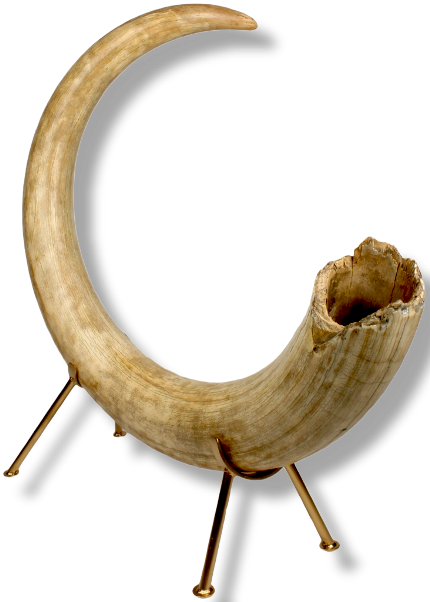
Few materials can claim a story like that. Mammoth ivory was carved by some of the very first modern humans to reach Europe, and it remains one of the very few genuinely ancient natural materials that can still be worked and worn today. It comes from the tusks of the woolly mammoth (Mammuthus primigenius), an animal of the Ice Age that has been extinct for thousands of years. To wear it is to wear something that existed long before you, and will exist long after.
Worn Since the Ice Age
She is not alone. At Sunghir people buried their dead more than 30,000 years ago adorned with mammoth ivory. Two boys, laid head to head in a single grave, were accompanied by more than 10,000 mammoth ivory beads and more than twenty ivory armbands. A man buried at the same site wore around 3,000 beads, probably once sewn onto his clothing, and ivory armbands of his own.
The beads were not strung at random. Strings found still in their original order suggest that their makers combined eight different types of ivory bead and arranged them with evident intent: sometimes around a central group, sometimes graded by size from one end of the string to the other. Sites of the same age in southern Germany show the same principle of combining different beads into a single string.
Each bead was shaped and perforated individually: a patient, deliberate act of adornment, made by people who already understood what a beautiful thing worn close to the body can mean.
A Material Coloured by Time
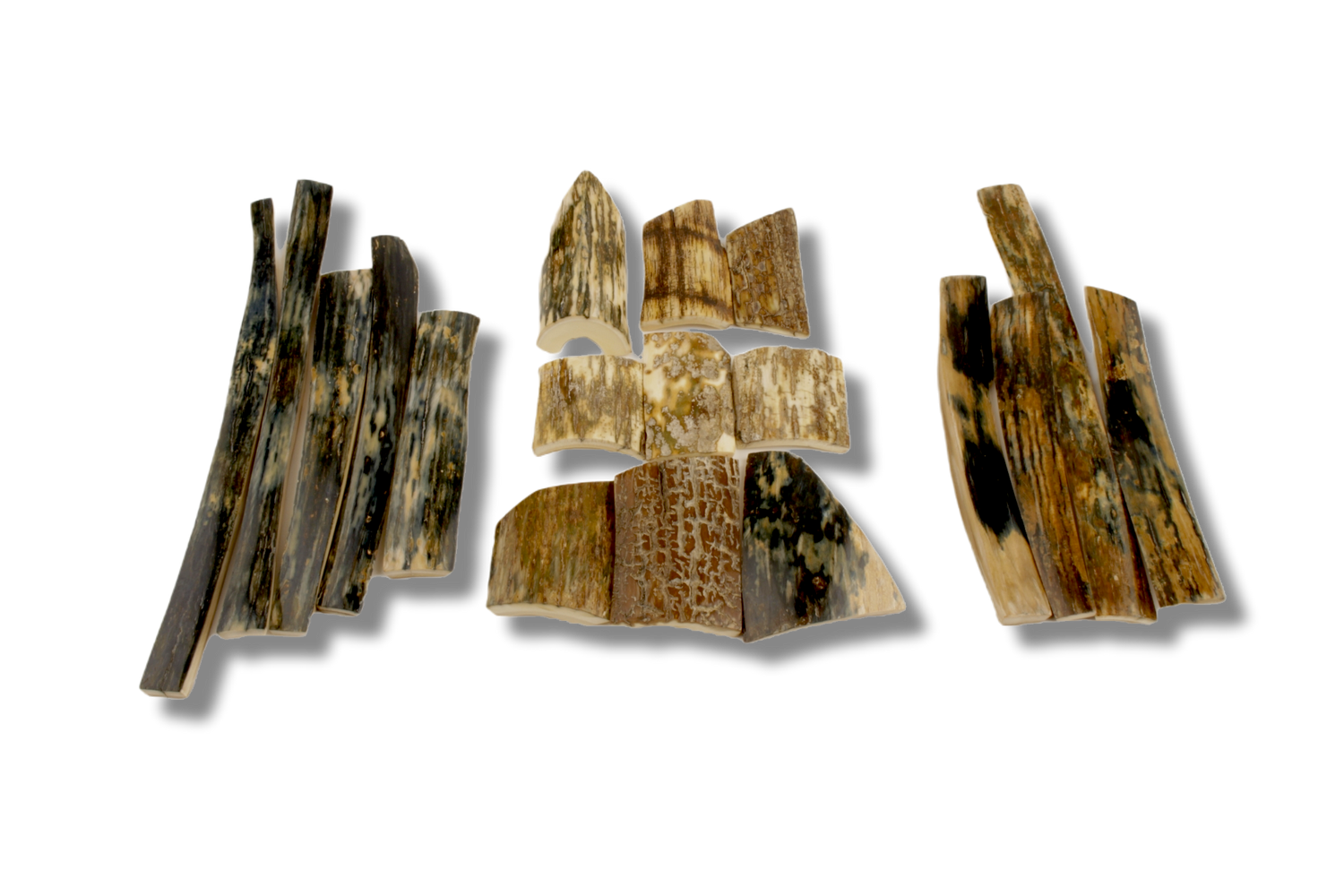
Mammoth ivory arrives with its palette already chosen: by minerals, by water moving through the ground, and by millennia of burial in frozen earth.
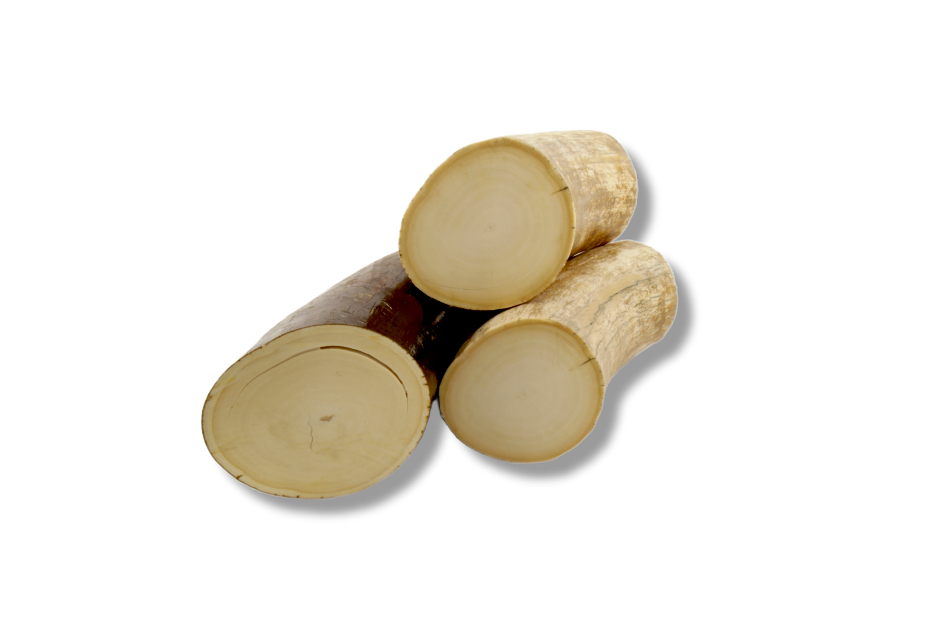
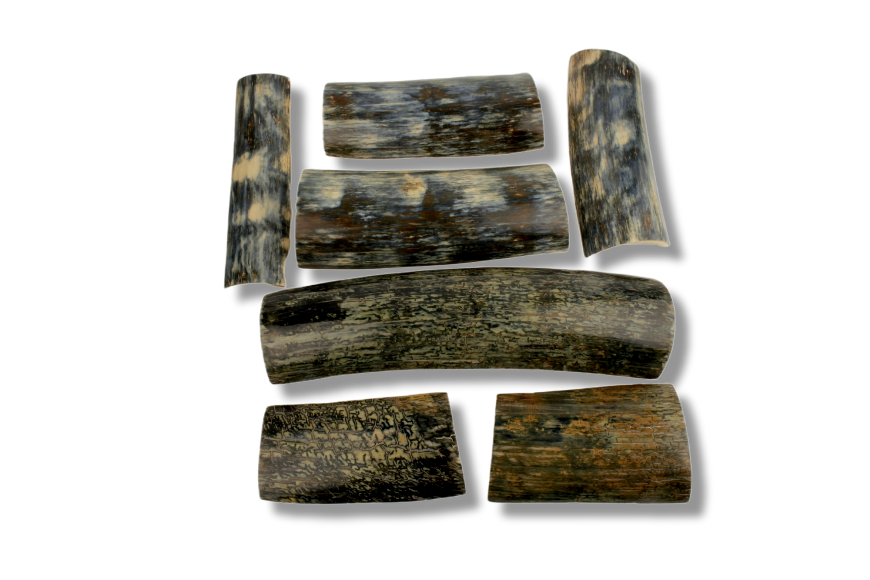
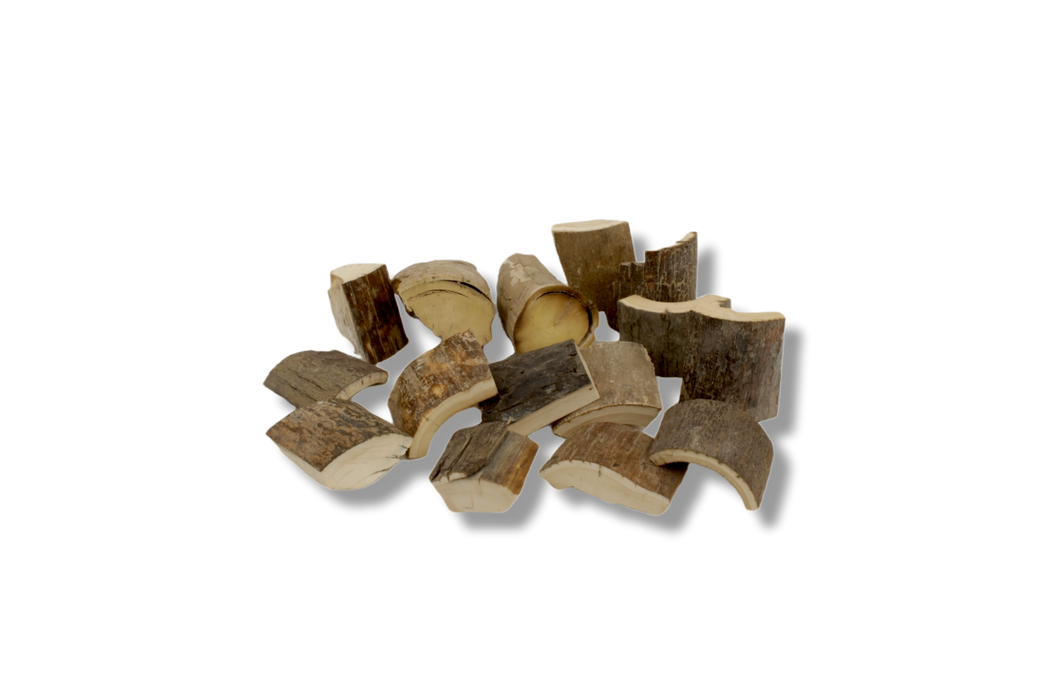
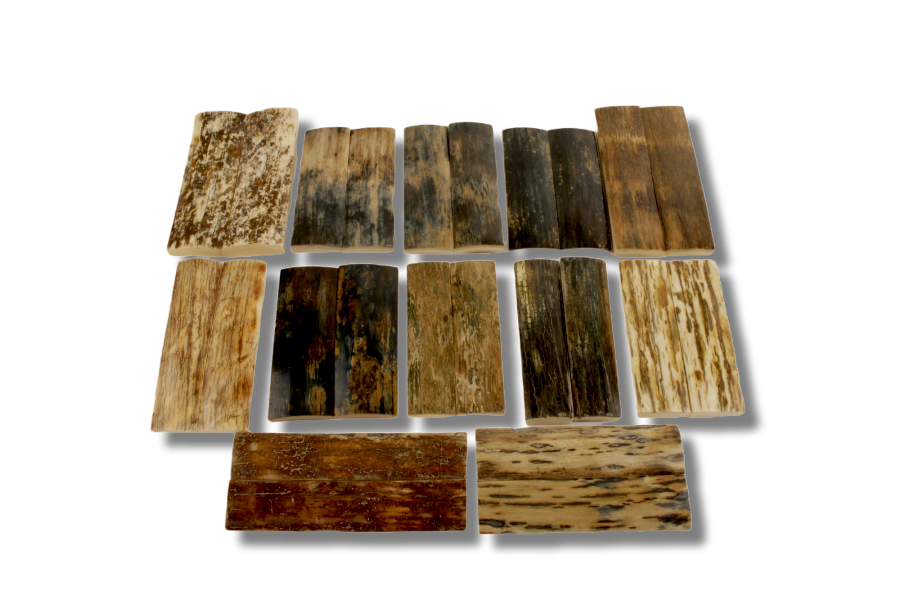
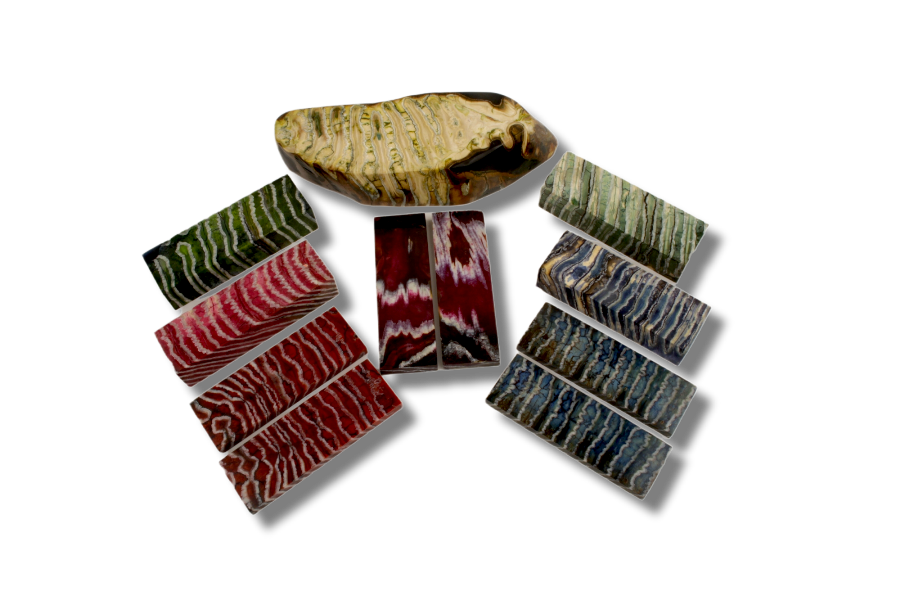
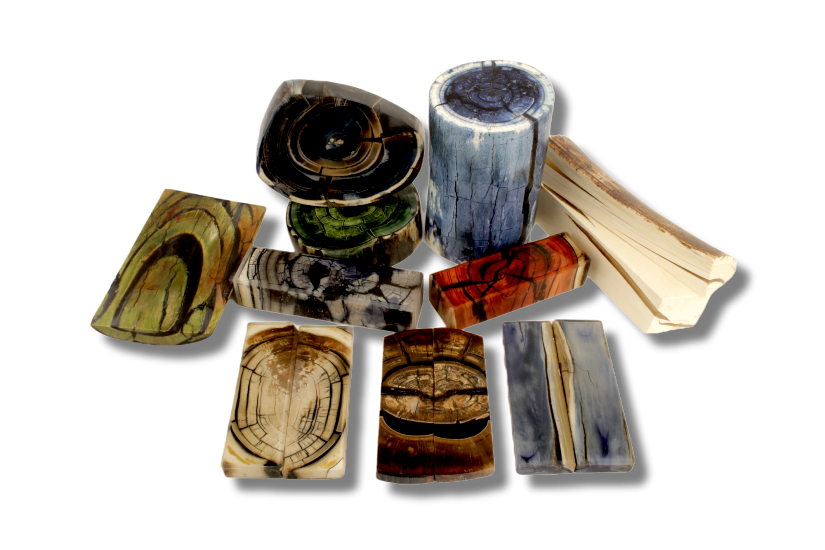
The heart of the tusk is dentine, the creamy-white material most people picture when they hear the word ivory. Its outer layer, the mammoth bark, tells a different story. Iron and manganese minerals that crystallised on its surface during burial gave it brown tones, from pale honey to deep chocolate. In rarer pieces, vivianite, an iron phosphate that forms as iron entering the tusk reacts with the phosphate in the ivory, has left shades of blue. In natural, untreated mammoth ivory, these colours are the material's own, not applied dyes. How bark and inner ivory relate to each other is explained in "Mammoth Ivory vs Mammoth Bark: What Is the Difference?"
Cut across the tusk and polished, mammoth ivory can reveal a quieter secret: the Schreger pattern, a fine cross-hatching of curved lines formed by the structure of the dentine itself, and seen only in the ivory of mammoths, elephants and their relatives. It is the kind of detail its wearer comes to know by heart.
No two pieces of mammoth ivory share the same colour or pattern. A design can be repeated; the ivory in it cannot.
Ivory, Not Stone
Mammoth ivory is called fossil ivory, and rightly so: it is the preserved remains of an extinct animal. Yet it has not turned to stone, which is why it is more precisely described as subfossil. Research published in Scientific Reports found well-preserved mammoth ivory from the Siberian permafrost to be comparable in composition and mechanical properties to the ivory of modern African elephants. That helps explain why it can be cut, carved and polished with techniques familiar to ivory workers, while keeping the natural structure and character of the original dentine. Where it comes from and what it is made of is told in full in "What Is Mammoth Ivory?"
Timeless, Not Old-Fashioned
Say "ivory jewellery", and some people still picture a cameo brooch in a grandmother's jewellery box. Mammoth ivory has every right to that history, and no obligation to stay there.
Look at it with fresh eyes. Its colours are the colours of the earth, from cream and honey through caramel to deep chocolate, with the rare, deep blue of vivianite. Its bark can be raw and textured, its polished inner ivory smooth and luminous. Set against polished silver or gold, beside a natural gemstone, or on its own in a clean, simple form, it looks less like an heirloom from the past than like something found. Which is exactly what it is.
That is why it belongs as naturally in a pair of statement earrings or a silver ring as in a quiet pendant, and why it is as much at home with linen and denim as with an evening dress. In a world of identical, mass-produced accessories, a piece whose ivory exists nowhere else is the most personal thing you can wear. Mammoth ivory does not follow trends. It simply never looks out of place.
Made Slowly, in Germany
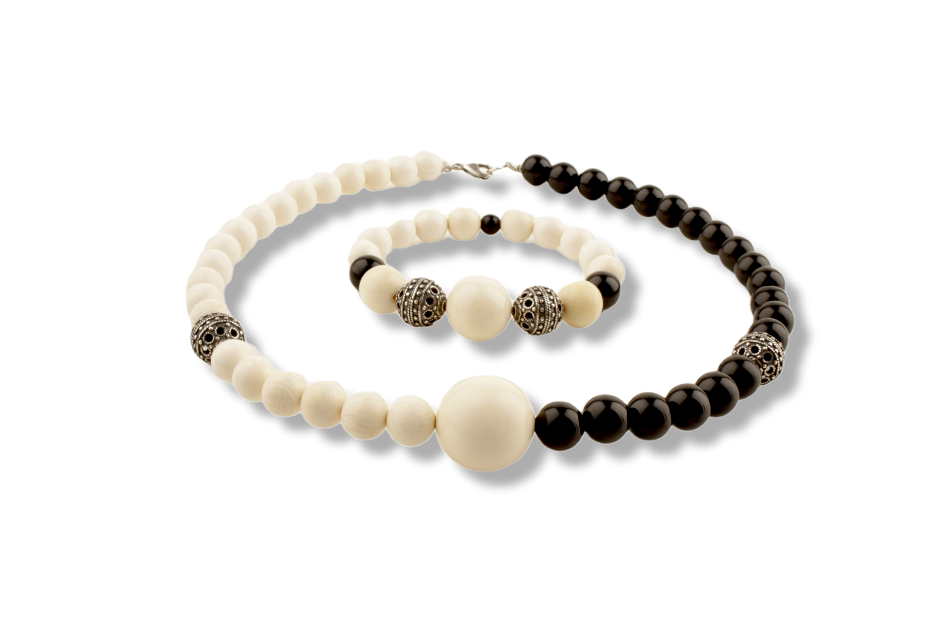
Our own Handcrafted Jewellery is designed and made in Germany, in small batches, combining mammoth ivory with natural gemstones and fine metals such as silver and gold. The range runs from handmade silver rings to statement earrings and nature-inspired pieces, from the bohemian to the quietly chic. Mammoth ivory, with its grain and its sometimes fragile nature, asks for skilled hands, and each piece is made to show the character of its ivory rather than to hide it.
Some pieces are one of a kind. Others are designs our clients return to again and again, and even these are never quite identical, because the ivory in each one is different. When you choose a piece, look at it as a whole: the colour and markings of its ivory, and the way the design frames them. That is where its individuality lies.
For the moments that call for something made especially, we create bespoke pieces in collaboration with our clients, for a wedding, as a gift, or simply to be worn. Write to us with the occasion and the idea you have in mind.
Retailers who would like to offer our work are invited to contact us.
A Gift Beyond the Ordinary
Some people already own everything that can be ordered twice. What they rarely own is something that exists only once.
A piece of mammoth ivory jewellery carries a story no one invented: a material that grew as part of a single animal of the Ice Age, lay for thousands of years in the frozen ground of Siberia, and was shaped by hand into something to wear. For her or for him, for a milestone birthday, an anniversary, a wedding, or simply a moment worth marking, it says that a gift was chosen with thought. And when nothing in the collection is quite right, one can be made.
Made to Be Kept
Trends change; a well-chosen piece of mammoth ivory jewellery can stay meaningful long after the season in which it was bought. Its material is finite, and no new mammoth ivory will ever grow. Nor is it obtained by hunting any living animal: the woolly mammoth has been extinct for thousands of years, its last known population surviving on Wrangel Island in the Arctic Ocean until about 4,000 years ago. How fossil mammoth ivory is sourced and documented, and how the claims of any supplier can be tested, is set out in "The Business of Ethical Mammoth Ivory: Sourcing, Identification and Verification."
Treated with a little care, a piece can be worn for years and one day handed on. Mammoth ivory is a natural material and asks to be treated as one; how to wear it, clean it and store it is explained in "Care for Mammoth Ivory Jewellery." The rules on mammoth ivory also differ from one country to another, and in some places it is restricted, so before buying a piece or sending one abroad as a gift, see "Is Mammoth Ivory Legal? A Buyer's Guide to CITES, National Law and Customs."
A Thread Through Time
Whoever wore the Venus of Hohle Fels is long gone, and so are the people of Sunghir. The ivory remains. To wear a piece of it today is to pick up a thread that runs back to the Ice Age, and to carry it a little further.
If you have any questions, please email us: info@arcticantiques.com
Bibliography:
Conard, N. J. (2009). "A female figurine from the basal Aurignacian of Hohle Fels Cave in southwestern Germany". Nature, 459(7244): 248–252. DOI: 10.1038/nature07995. (The Venus of Hohle Fels, carved from mammoth ivory at least 35,000 years ago; the polished ring suggesting that the figurine was at times suspended as a pendant; ivory working by early modern humans in Europe.)
Espinoza, E. O.; Mann, M.-J. (1991). Identification Guide for Ivory and Ivory Substitutes. World Wildlife Fund and The Conservation Foundation; subsequently published by the CITES Secretariat. (The Schreger pattern as a feature of proboscidean ivory.)
Huang, Z.; Chen, T.; Zheng, J.; Wang, D.; Xu, X. (2023). "Origins of Color in Brown Mammoth Ivory". Gems & Gemology, 59(2). Gemological Institute of America. (Iron and manganese minerals crystallised during burial as the cause of brown colouration.)
Khlopachev, G. A.; Gavrilov, K. N.; Bazilevich, L. O.; Saifieva, A. Y. (2025). "Ivory Bead Ornaments from the Sungir Paleolithic Site". Archaeology, Ethnology & Anthropology of Eurasia, 53(3): 36–44. DOI: 10.17746/1563-0110.2025.53.3.036-044. (Strings preserved in their original order; eight bead types; stringing techniques; parallels with contemporaneous sites in southern Germany.)
Pfeifer, S. J.; Hartramph, W. L.; Kahlke, R.-D.; Müller, F. A. (2019). "Mammoth ivory was the most suitable osseous raw material for the production of Late Pleistocene big game projectile points". Scientific Reports, 9: 2303. (Composition and mechanical properties of permafrost mammoth ivory compared with modern elephant ivory.)
Shen, M.; Lu, Z.; Xu, Y.; He, X. (2021). "Vivianite and Its Oxidation Products in Mammoth Ivory and Their Implications to the Burial Process". ACS Omega, 6(34): 22284–22291. DOI: 10.1021/acsomega.1c02964. (Vivianite formed by infiltrating iron reacting with the phosphate in the ivory, as the cause of blue colouration; yellowish-white dentine.)
Trinkaus, E.; Buzhilova, A. P. (2018). "Diversity and differential disposal of the dead at Sunghir". Antiquity, 92(361). (The Sunghir burials; numbers of mammoth ivory beads and armbands recovered.)
Vartanyan, S. L.; Garutt, V. E.; Sher, A. V. (1993). "Holocene dwarf mammoths from Wrangel Island in the Siberian Arctic". Nature, 362(6418): 337–340. (Survival of the last woolly mammoths on Wrangel Island until approximately 4,000 years ago.)