How to Display Fossil Mammoth Tusks: A Collector's Guide to Care, Mounting & Interior Design
Fossil mammoth tusks (Mammuthus primigenius) are among the most impressive natural objects available to display in a private collection, hunting lodge, luxury residence or commercial interior. Every mammoth tusk is unique, having spent thousands of years preserved in the Siberian permafrost before being carefully recovered and professionally prepared for display.
Whether you are a collector adding a museum-quality specimen to a private collection, an interior designer sourcing a statement piece for a client, or someone furnishing a hunting chalet or country estate, a fossil mammoth tusk offers a rare combination of natural history, craftsmanship and design that few other objects can match. This guide covers everything you need to know about choosing a location, mounting, cleaning and displaying a mammoth tusk correctly.
Choosing the Right Location to Display a Mammoth Tusk
Mammoth tusks should be displayed in a stable indoor environment with normal room temperature and normal humidity. Like any natural fossil material, they should not be exposed to permanent direct sunlight or excessive heat for long periods of time.
A small amount of natural daylight is perfectly acceptable and forms part of normal everyday conditions. However, we do not recommend placing a mammoth tusk directly in front of large, south-facing windows with constant strong sunlight throughout the day.
Likewise, tusks should not be displayed directly next to fireplaces, radiators or other permanent heat sources. They should also not be positioned immediately beside open water features, indoor fountains or other areas with continuously elevated humidity.
Cool rooms and temperatures below normal room temperature generally do not present any problem, provided that the environment remains stable and free from extreme fluctuations. This makes mammoth tusks equally well suited to a heated living room and an unheated hunting lodge or entrance hall.
Professionally Dried for Long-Term Stability
All mammoth tusks offered by Arctic Antiques have been professionally dried under carefully controlled climatic conditions for many years before being offered for sale. This slow, controlled drying process helps minimise internal stresses, significantly reduces the likelihood of new cracks developing, and enhances the long-term structural stability of the inner core.
Because of this extensive preparation process, our fossil mammoth tusks require no special ongoing maintenance under normal indoor conditions, making them a genuinely low-maintenance statement piece for a busy household or commercial space.
How to Clean and Maintain a Mammoth Tusk
Mammoth tusks require very little maintenance.
Dust can simply be removed occasionally using a soft, dry cotton cloth. No polishing, waxing or special treatment is normally required.
Detergents, household cleaners, chemical solutions, alcohol or other cleaning products should never be used. Mammoth ivory is a natural fossil material, and aggressive cleaning products are unnecessary and should always be avoided.
Mammoth Tusk Display Ideas for Every Interior
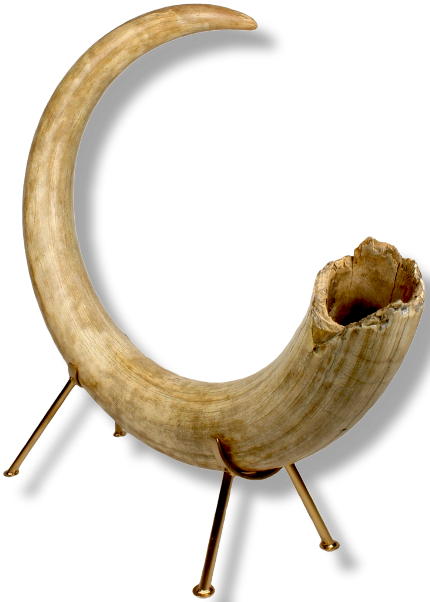
Many people imagine mammoth tusks displayed on floor stands, as commonly seen in museums or galleries. While this is certainly one attractive option, it is far from the only possibility.
Depending on the available space and the overall interior design concept, a fossil mammoth tusk can also be:
- mounted on vertical feature walls
- suspended from ceilings as a dramatic overhead centrepiece
- integrated into bookshelves or office interiors
- displayed within a private natural history collection
- incorporated into hunting lodges and country homes, alongside antlers, skins and other trophies
- presented in luxury hotel lobbies or reception areas
- combined with natural stone, timber or contemporary architectural elements
There is no single correct way to display a mammoth tusk. Every interior is different, and the final presentation depends entirely on personal preference and the overall design concept, whether that is a rustic hunting chalet, a minimalist penthouse or a traditional library.
Correct Mounting: Why a Professional Tusk Stand Matters
Regardless of the chosen display method, correct mounting is essential.
Every mammoth tusk has its own natural curvature, weight distribution and centre of gravity. Mounting systems should therefore be designed to support the tusk evenly along its natural shape, rather than concentrating the load at only one point.
Proper weight distribution not only creates a visually balanced presentation but also helps protect the tusk over the long term. For larger collector specimens in particular, a professionally designed mounting system or custom stand is always recommended over improvised supports.
Single Tusks vs Matched Pairs: A Statement Piece for Any Interior
Whether displayed individually or as a matched pair, mammoth tusks create an immediate focal point. They complement a wide variety of interiors, from traditional hunting chalets and private libraries to modern architectural homes, executive offices and luxury commercial spaces.
Because every fossil mammoth tusk differs in size, curvature, colour and natural character, no two displays will ever be exactly alike. Collectors seeking a truly one-of-a-kind interior feature often choose a matched pair, flanking an entrance, fireplace or staircase for maximum visual impact.
Certificate of Origin: Documentation and Provenance
Every large mammoth tusk in our Tusks collection is accompanied by a Certificate of Origin, issued on our application by the German Chamber of Industry and Commerce (IHK). It documents the declared origin of the tusk; it is not a scientific authentication of the specimen. Kept with the tusk, it is an important document for insurance purposes and for any future resale.
Frequently Asked Questions
Is it legal to buy and own a mammoth tusk?
Mammoth ivory is not regulated under CITES or the U.S. Endangered Species Act, since woolly mammoths have been extinct for thousands of years and are not a protected living species. A small number of jurisdictions, including a few U.S. states, have nonetheless extended their ivory regulations to cover mammoth ivory alongside elephant ivory. We recommend collectors and designers check local regulations for their specific location, and our Certificate of Origin is designed to support exactly this kind of due diligence.
Can a mammoth tusk be displayed outdoors?
No. Mammoth tusks are fossil material and should always be displayed indoors, in a stable environment protected from rain, direct sun and fluctuating temperature or humidity.
Do mammoth tusks need a humidifier or climate control?
Not under normal indoor living conditions. Because our tusks are professionally dried over several years before sale, standard household or office climate conditions are sufficient. Extreme, prolonged heat or dryness (such as directly above a radiator) should still be avoided.
How should a large mammoth tusk be mounted safely?
Large or heavy specimens should always use a custom-built stand or wall mount designed around that specific tusk's curvature and centre of gravity, distributing the weight evenly rather than resting on a single point.
Can mammoth tusks be shipped internationally?
Yes, mammoth tusks are regularly shipped internationally to collectors, designers and hunting lodges worldwide. Documentation such as a Certificate of Origin helps ensure smooth customs clearance; specific import requirements vary by destination country.
A Rare Piece of Natural History for Discerning Collectors
With professional preparation, correct display and a stable indoor environment, a fossil mammoth tusk can be enjoyed for generations while remaining one of nature's most remarkable collector's pieces. If you are sourcing a single specimen or a matched pair for a private collection, hunting lodge or interior design project, browse our current selection of fossil mammoth tusks.
If you have any further questions or would like guidance on choosing or mounting a specimen for your space, please email us: info@arcticantiques.com
Bibliography
Espinoza, E. O.; Mann, M.-J. (1991). Identification Guide for Ivory and Ivory Substitutes. CITES Secretariat.
"Trade in Mammoth Ivory" (CoP17 Doc. 38). Convention on International Trade in Endangered Species of Wild Fauna and Flora (CITES).
U.S. Fish & Wildlife Service. Ivory Identification Guide and public guidance on ivory regulation.
Lister, A. M.; Sher, A. V.; Van Essen, H.; Wei, G. (2005). "The pattern and process of mammoth evolution in Eurasia". Quaternary International. 126–128: 49–64.